HTLaw

CÁC ĐIỂM MỚI CỦA NGHỊ ĐỊNH 219/2025/NĐ-CP QUY ĐỊNH VỀ NGƯỜI LAO ĐỘNG NƯỚC NGOÀI LÀM VIỆC TẠI VIỆT NAM CÓ HIỆU LỰC TỪ NGÀY 07/08/2025

Thứ nhất: Về điều kiện cấp GPLĐ cho chuyên gia được nới lỏng

Cụ thể căn cứ khoản 3 Điều 3 Nghị định 219/2025/NĐ-CP, chuyên gia là người:

– Có bằng đại học trở lên và ít nhất 2 năm kinh nghiệm làm việc phù hợp; hoặc

– Có bằng đại học và ít nhất 1 năm kinh nghiệm nếu làm trong các lĩnh vực đặc thù như: khoa học, công nghệ, đổi mới sáng tạo, chuyển đổi số quốc gia hoặc lĩnh vực ưu tiên phát triển kinh tế – xã hội.

Trước đây, theo khoản 3 Điều 3 Nghị định 152/2020/NĐ-CP, mọi trường hợp chuyên gia đều yêu cầu tối thiểu 3 năm kinh nghiệm làm việc phù hợp.

Thứ hai: Thay đổi về cơ quan cấp giấy phép lao động cho người nước ngoài

Theo Điều 4 Nghị định 219/2025/NĐ-CP quy định thẩm quyền cấp, cấp lại, gia hạn, thu hồi giấy phép lao động và giấy xác nhận không thuộc diện cấp giấy phép lao động như sau:

  1. Ủy ban nhân dân cấp tỉnh có thẩm quyền cấp, cấp lại, gia hạn, thu hồi giấy phép lao động và giấy xác nhận không thuộc diện cấp giấy phép lao động đối với người lao động nước ngoài làm việc cho người sử dụng lao động có trụ sở, chi nhánh, văn phòng đại diện hoặc địa điểm kinh doanh tại địa phương nơi người lao động nước ngoài dự kiến làm việc.

Trường hợp người lao động nước ngoài làm việc cho một người sử dụng lao động tại nhiều tỉnh, thành phố trực thuộc trung ương, Ủy ban nhân dân cấp tỉnh nơi người sử dụng lao động có trụ sở chính có thẩm quyền cấp, cấp lại, gia hạn, thu hồi giấy phép lao động và giấy xác nhận không thuộc diện cấp giấy phép lao động.

  1. Ủy ban nhân dân cấp tỉnh quyết định việc phân cấp cho cơ quan có thẩm quyền thực hiện việc cấp, cấp lại, gia hạn, thu hồi giấy phép lao động và giấy xác nhận không thuộc diện cấp giấy phép lao động theo quy định của pháp luật.

Do vậy, UBND cấp tỉnh vừa là cơ quan cấp phép giấy phép lao động cho người nước, vừa có thể phân cấp cho các cơ quan chuyên môn trực thuộc thực hiện.

Thứ ba: Có thể cùng lúc hồ sơ xin Giấy phép lao động và hồ sơ xin Lý lịch tư pháp trên Cổng Dịch Vụ Công Quốc Gia (DVCQG)

Tại khoản 3 Điều 6 Nghị định 219/2025/NĐ-CP bổ sung quy trình liên thông thực hiện đồng thời thủ tục cấp giấy phép lao động và Phiếu lý lịch tư pháp trên Cổng Dịch vụ công quốc gia.

Theo đó, người sử dụng lao động có thể nộp cùng lúc hai loại hồ sơ qua trực tuyến:

–  Hồ sơ đề nghị cấp giấy phép lao động;

– Hồ sơ đề nghị cấp Phiếu lý lịch tư pháp (theo ủy quyền từ người lao động nước ngoài).

Quy trình liên thông được vận hành giữa Cổng DVCQG, cơ quan cấp giấy phép lao động (thuộc UBND tỉnh) và cơ quan công an cấp Phiếu lý lịch tư pháp. Kết quả là giấy phép lao động và Phiếu lý lịch tư pháp bản điện tử sẽ được trả về đồng thời.

Thứ tư: Bổ sung thêm các trường hợp người nước ngoài không cần giấy phép lao động

Tại Điều 7 Nghị định 219/2025/NĐ-CP quy định 15 trường hợp người nước ngoài không cần giấy phép lao động tại Việt Nam

Cụ thể đã bổ sung thêm trường hợp người nước ngoài làm việc trong các lĩnh vực tài chính, khoa học, công nghệ, đổi mới sáng tạo, chuyển đổi số quốc gia, lĩnh vực ưu tiên phát triển kinh tế – xã hội, được các bộ, cơ quan ngang bộ hoặc UBND cấp tỉnh xác nhận.

Thứ năm: Người nước ngoài làm việc dưới 90 ngày/năm không thuộc diện cấp GPLĐ

Cụ thể điểm a khoản 13 Điều 7 Nghị định 219/2025/NĐ-CP, người lao động nước ngoài làm việc tại Việt Nam có tổng thời gian làm việc dưới 90 ngày trong một năm (tính từ ngày 01/01 đến hết 31/12) không thuộc diện cấp giấy phép lao động.

Tuy nhiên, theo khoản 4 Điều 9, doanh nghiệp sử dụng lao động trong trường hợp này phải gửi thông báo bằng văn bản đến cơ quan có thẩm quyền trước ít nhất 03 ngày làm việc.

Trước đây, theo khoản 2 Điều 7 Nghị định 152/2020/NĐ-CP cũng miễn GPLĐ cho trường hợp dưới 30 ngày/lần và không quá 90 ngày/năm, nhưng không quy định rõ trách nhiệm thông báo.

Thứ sáu: Thay đổi về việc thông báo đối với trường hợp không cần giấy xác nhận miễn GPLĐ

Theo khoản 4 Điều 9 Nghị định 219/2025/NĐ-CP quy định:

Trường hợp quy định tại các khoản 4, 5, 6 và 8 Điều 154 của Bộ luật Lao động, quy định tại các khoản 2, 3, 5, 8, 10 và điểm a khoản 13 Điều 7 Nghị định này không phải làm thủ tục cấp giấy xác nhận không thuộc diện cấp giấy phép lao động nhưng phải thông báo với cơ quan có thẩm quyền cấp giấy xác nhận không thuộc diện cấp giấy phép lao động nơi người lao động nước ngoài dự kiến làm việc trước ít nhất 3 ngày làm việc, kể từ ngày người lao động nước ngoài dự kiến bắt đầu làm việc tại Việt Nam.

Thông báo gồm các nội dung cơ bản sau: họ và tên, ngày tháng năm sinh, quốc tịch, số hộ chiếu, tên người sử dụng lao động nước ngoài, địa điểm làm việc và thời hạn làm việc.

Trước đây, khoản Điều 8 Nghị định 152/2020/NĐ-CP trường hợp không phải làm thủ tục cấp giấy xác nhận không thuộc diện cấp giấy phép lao động phải báo cáo với Bộ Lao động – Thương binh và Xã hội hoặc Sở Lao động – Thương binh và Xã hội.

Thứ bảy: Được cấp GPLĐ tại một tỉnh được làm việc ở nhiều địa phương

Theo quy định tại khoản 5 Điều 22 Nghị định 219/2025/NĐ-CP cho phép:

– Người lao động nước ngoài đã có GPLĐ được phép làm việc tại nhiều tỉnh, thành phố trực thuộc trung ương;

Tuy nhiên, trước mỗi lần di chuyển làm việc tại tỉnh/thành khác, doanh nghiệp phải thông báo trước ít nhất 03 ngày làm việc đến cơ quan có thẩm quyền tại địa phương nơi người lao động dự kiến làm việc.

Thứ tám: Bổ sung căn cứ xác định thời hạn giấy phép lao động và giấy xác nhận

Tại Điều 21 Nghị định 219/2025/NĐ-CP quy định thời hạn của GPLĐ và giấy xác nhận miễn GPLĐ không quá 02 năm;

Căn cứ theo thời hạn của các loại giấy tờ như: hợp đồng lao động, văn bản cử đi công tác, thỏa thuận quốc tế, giấy phép hoạt động của doanh nghiệp…

Khoản 1 Điều 10 Nghị định 152/2020/NĐ-CP cũng giới hạn tối đa 02 năm, nhưng không liệt kê đầy đủ các loại căn cứ xác định thời hạn như Nghị định 219/2025/NĐ-CP.

Thứ chín: Mở rộng về căn cứ thu hồi giấy phép lao động và giấy xác nhận miễn GPLĐ

Theo Điều 30, 32 Nghị định 219/2025/NĐ-CP quy định các trường hợp bị thu hồi GPLĐ hoặc giấy xác nhận không thuộc diện cấp GPLĐ bao gồm:

– Giấy tờ hết hiệu lực;

– Người lao động, doanh nghiệp vi phạm nghĩa vụ cấp, gia hạn hoặc sử dụng sai mục đích GPLĐ;

– Người lao động nước ngoài bị khởi tố, truy cứu trách nhiệm hình sự;

– Doanh nghiệp chấm dứt hoạt động;

– Có văn bản của bên cử lao động thông báo ngừng làm việc.

Để tiết kiệm thời gian tìm hiểu các thủ tục, điền form mẫu, công chứng, chờ đợi nộp hồ sơ, các bạn có thể liên hệ HT để được tư vấn và hỗ trợ về Giấy phép lao động

Liên hệ với chúng tôi

    • Email: hue.truong@htlaw.vn
    • SĐT: +84 935 439 454.

ARE YOU INVESTOR OR ENTREPERNEUR WHO WANT TO INVESTMENT IN VIETNAM? IF YES, DO NOT MISS THIS ARTICLE?

To invest or open a business in Vietnam, investors must follow several procedures, including obtaining licenses, opening a bank account, submitting tax documents, and contributing capital within 90 days from the date of receiving the enterprise registration certificate, so on.

All these steps are important, but today I would like to highlight a particularly critical issue: capital contribution within the required 90-day period.

It is essential to alert all investors to pay close attention to this requirement, as failure to comply can seriously impact your business and result in significant penalties.

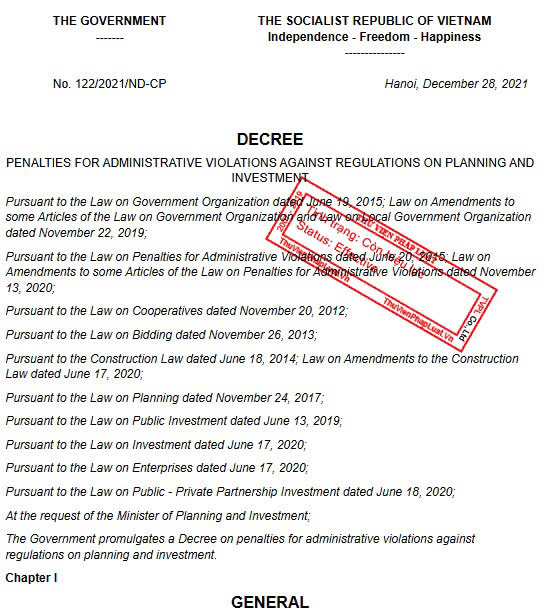
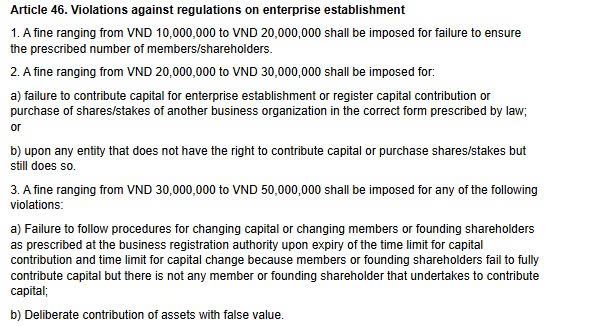
According to Decree 122/2021 – Penalties for Administrative Violations Against Regulations on Planning and Investment,
Clause 3: A fine ranging from VND 30,000,000 to VND 50,000,000 shall be imposed for the following violations.
In some cases, depending on the situation, authorities may impose a higher fine.

So, if you transfer the capital into your capital account in Vietnam after the 90-day deadline, counted from the date of receiving the Enterprise Registration Certificate, your business may face the following consequences:

  1. A financial penalty as mentioned above.
  2. Delays in business activities, as banks may refuse to process capital contributions until you obtain an extension of your Investment Registration Certificate.
  3. In the worst-case scenario, your company may risk having its licenses—such as the Investment License or Business License—revoked if it fails to comply with penalties or other regulatory requirements.

We hope this information is helpful as you prepare to do business in Vietnam. To ensure full compliance with all legal requirements, it is highly recommended to work with a qualified lawyer or consultancy firm who can guide you before and after your business launch.

At HT—short for Honesty and Trust—we are dedicated to delivering genuine value to our clients. Your success is our success, and we are committed to minimizing any potential risks to your business.

If you have any questions about this topic or any legal matters in Vietnam, feel free to contact us.

To save time on researching procedures, filling out forms, notarizing, and waiting to submit documents, you can contact HT for consultation and assistance for  Investment

Contact us at:

Email: hue.truong@htlaw.vn

Phone: +84 935 439 454.

Thủ tục cấp Giấy xác nhận có quốc tịch Việt Nam từ ngày 01/7/2025

Vừa qua Chính Phủ ban hành Nghị định 191 quy định chi tiết về hướng dẫn thủ tục cấp Giấy xác nhận có quốc tịch Việt Nam từ ngày 01/7/2025.

Chính phủ ban hành Nghị định 191/2025/NĐ-CP ngày 01/7/2025 quy định chi tiết một số điều và biện pháp để tổ chức, hướng dẫn Luật Quốc tịch Việt Nam 2008.

Theo đó, quy định chi tiết về trình tự, thủ tục cấp Giấy xác nhận có quốc tịch Việt Nam cụ thể như sau:

  1. Người yêu cầu cấp Giấy xác nhận có quốc tịch Việt Nam lập 01 bộ hồ sơ, gồm Tờ khai theo mẫu quy định, kèm 2 ảnh 4 x 6 chụp chưa quá 06 tháng và bản sao các giấy tờ sau:

+ Giấy tờ chứng minh nhân thân của người đó như thẻ Căn cước công dân, thẻ căn cước, căn cước điện tử, giấy tờ cư trú, thẻ tạm trú, giấy thông hành, giấy tờ có giá trị đi lại quốc tế hoặc giấy tờ xác nhận về nhân thân có dán ảnh do cơ quan có thẩm quyền cấp;

+ Giấy tờ có giá trị chứng minh quốc tịch Việt Nam theo quy định tại Điều 11 Luật Quốc tịch Việt Nam 2008 và Điều 7 Nghị định 191/2025/NĐ-CP hoặc giấy tờ tương tự do chính quyền cũ trước đây cấp, kể cả Giấy khai sinh trong đó không có mục quốc tịch hoặc mục quốc tịch bỏ trống nhưng trên đó ghi họ tên Việt Nam của người yêu cầu và cha, mẹ của người đó, trong trường hợp cơ quan tiếp nhận không thể khai thác được thông tin chứng minh quốc tịch Việt Nam của người yêu cầu cấp Giấy xác nhận có quốc tịch Việt Nam trong Cơ sở dữ liệu hộ tịch điện tử, Cơ sở dữ liệu quốc gia về dân cư;

+ Trong trường hợp không có giấy tờ chứng minh quốc tịch Việt Nam theo quy định tại điểm b khoản 1 Điều 30 Nghị định 191/2025/NĐ-CP, người yêu cầu xin cấp Giấy xác nhận có quốc tịch Việt Nam phải lập bản khai lý lịch kèm theo một trong các giấy tờ sau để có cơ sở xác minh quốc tịch Việt Nam:

  • Giấy tờ về quốc tịch, hộ tịch, hộ khẩu, căn cước hoặc giấy tờ khác do cơ quan có thẩm quyền của Việt Nam cấp cho công dân Việt Nam qua các thời kỳ, trong đó có ghi quốc tịch Việt Nam hoặc thông tin liên quan đến quốc tịch, công dân Việt Nam;
  • Giấy tờ về quốc tịch, hộ tịch, hộ khẩu, căn cước hoặc giấy tờ khác do chế độ cũ ở miền Nam Việt Nam hoặc giấy tờ do chính quyền cũ ở miền Bắc Việt Nam cấp, trong đó có ghi quốc tịch Việt Nam hoặc thông tin liên quan đến quốc tịch công dân Việt Nam.

2. Trình tự kiểm tra, xác minh, tra cứu quốc tịch Việt Nam được thực hiện như sau:

+ Đối với trường hợp có giấy tờ chứng minh quốc tịch Việt Nam, nếu hồ sơ được nộp tại Sở Tư pháp thì trong thời hạn 05 ngày làm việc, kể từ ngày thụ lý hồ sơ, Sở Tư pháp kiểm tra hồ sơ, trực tiếp tra cứu hoặc có văn bản đề nghị Bộ Tư pháp tra cứu thông tin về thôi quốc tịch, tước quốc tịch, hủy bỏ Quyết định cho nhập quốc tịch Việt Nam, Quyết định cho trở lại quốc tịch Việt Nam; trong thời hạn 10 ngày làm việc Bộ Tư pháp tiến hành tra cứu và có văn bản trả lời Sở Tư pháp.

Nếu có nghi ngờ về tính xác thực của giấy tờ chứng minh quốc tịch Việt Nam thì Sở Tư pháp yêu cầu cơ quan đã cấp giấy tờ đó xác minh; trong thời hạn 10 ngày làm việc, kể từ ngày nhận được văn bản đề nghị của Sở Tư pháp, cơ quan đã cấp giấy tờ đó tiến hành xác minh và có văn bản trả lời Sở Tư pháp.

Trường hợp nộp hồ sơ tại cơ quan đại diện thì trong thời hạn 05 ngày làm việc, kể từ ngày thụ lý hồ sơ, cơ quan đại diện kiểm tra hồ sơ, trực tiếp tra cứu hoặc có văn bản gửi Bộ Ngoại giao đề nghị Bộ Tư pháp tra cứu thông tin về thôi quốc tịch, tước quốc tịch, hủy bỏ Quyết định cho nhập quốc tịch Việt Nam, Quyết định cho trở lại quốc tịch Việt Nam; trong thời hạn 10 ngày làm việc Bộ Tư pháp tiến hành tra cứu và có văn bản trả lời.

Nếu nghi ngờ về tính xác thực của giấy tờ chứng minh quốc tịch Việt Nam do cơ quan có thẩm quyền trong nước cấp thì cơ quan đại diện có văn bản gửi Bộ Ngoại giao để đề nghị cơ quan đã cấp giấy tờ đó xác minh; trong thời hạn 10 ngày làm việc, kể từ ngày nhận được văn bản đề nghị của Bộ Ngoại giao, cơ quan nhận được yêu cầu tiến hành xác minh và có văn bản trả lời Bộ Ngoại giao.

Trong thời hạn 05 ngày làm việc, kể từ ngày nhận được kết quả tra cứu, xác minh, Bộ Ngoại giao thông báo bằng văn bản cho cơ quan đại diện;

+ Đối với trường hợp người không có giấy tờ chứng minh quốc tịch Việt Nam, nhưng có giấy tờ quy định tại điểm c khoản 1 Điều 30 Nghị định 191/2025/NĐ-CP, nếu hồ sơ được nộp tại Sở Tư pháp thì trong thời hạn 05 ngày làm việc, kể từ ngày thụ lý hồ sơ, Sở Tư pháp chủ động tra cứu hoặc đề nghị Bộ Tư pháp tra cứu thông tin về thôi quốc tịch, tước quốc tịch, hủy bỏ Quyết định cho nhập quốc tịch Việt Nam, Quyết định cho trở lại quốc tịch Việt Nam, trong thời hạn 10 ngày làm việc Bộ Tư pháp tiến hành tra cứu và có văn bản trả lời Sở Tư pháp.

Đồng thời, Sở Tư pháp có văn bản đề nghị cơ quan Công an cấp tỉnh xác minh về nhân thân của người có yêu cầu. Trong thời hạn 45 ngày, kể từ ngày nhận được văn bản đề nghị của Sở Tư pháp, cơ quan Công an cấp tỉnh có trách nhiệm xác minh và trả lời kết quả bằng văn bản cho Sở Tư pháp; trường hợp phức tạp thì có thể kéo dài thêm nhưng không quá 60 ngày.

Nếu hồ sơ nộp tại cơ quan đại diện thì trong thời hạn 05 ngày làm việc, kể từ ngày thụ lý hồ sơ, cơ quan đại diện chủ động tra cứu hoặc có văn bản kèm theo bản chụp các giấy tờ, thông tin do người yêu cầu cung cấp gửi Bộ Ngoại giao đề nghị Bộ Tư pháp tra cứu thông tin về thôi quốc tịch, tước quốc tịch, hủy bỏ Quyết định cho nhập quốc tịch Việt Nam, Quyết định cho trở lại quốc tịch Việt Nam, đề nghị Bộ Công an xác minh về nhân thân của người có yêu cầu.

Trong thời hạn 10 ngày làm việc Bộ Tư pháp tiến hành tra cứu và có văn bản trả lời Bộ Ngoại giao; đối với việc xác minh và trả lời kết quả xác minh về nhân thân của Bộ Công an thì thời hạn là 45 ngày; trường hợp phức tạp thì có thể kéo dài thêm nhưng không quá 60 ngày. Trong thời hạn 05 ngày làm việc, kể từ ngày nhận được kết quả tra cứu, xác minh, Bộ Ngoại giao thông báo bằng văn bản cho cơ quan đại diện.

– Trong thời hạn 03 ngày làm việc, kể từ ngày nhận được kết quả tra cứu, xác minh theo quy định tại khoản 2 Điều 30 Nghị định 191/2025/NĐ-CP, nếu có đủ căn cứ để xác định quốc tịch Việt Nam và người đó không có tên trong danh sách được thôi quốc tịch, bị tước quốc tịch, bị hủy bỏ Quyết định cho nhập quốc tịch Việt Nam, Quyết định cho trở lại quốc tịch Việt Nam, cơ quan thụ lý hồ sơ ghi vào Sổ cấp Giấy xác nhận có quốc tịch Việt Nam; người đứng đầu cơ quan ký và cấp Giấy xác nhận có quốc tịch Việt Nam theo mẫu quy định cho người yêu cầu.

Nếu không có cơ sở để cấp Giấy xác nhận có quốc tịch Việt Nam, cơ quan thụ lý hồ sơ trả lời bằng văn bản cho người yêu cầu biết.

Liên hệ với chúng tôi

    • Email: hue.truong@htlaw.vn
    • SĐT: +84 935 439 454.

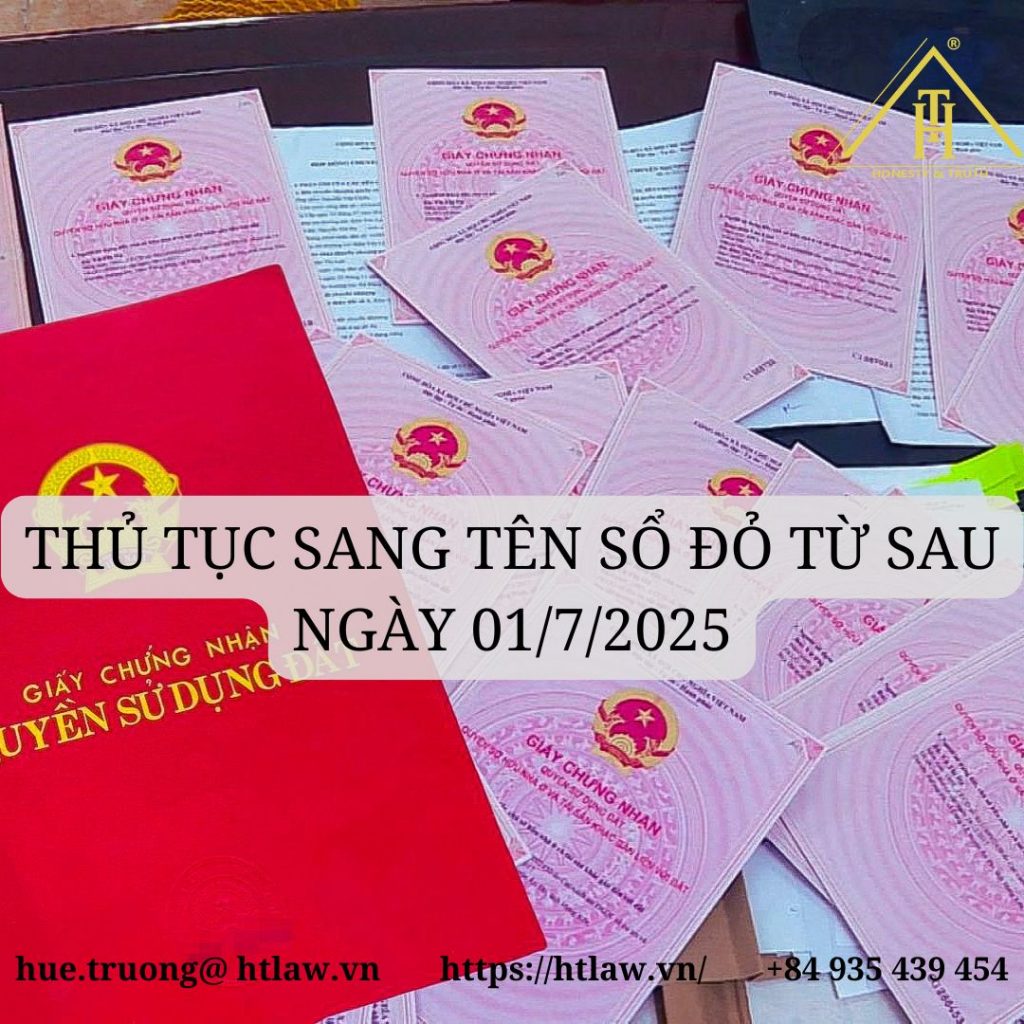
THỦ TỤC SANG TÊN SỔ ĐỎ TỪ SAU NGÀY 1/7 THẾ NÀO?

Căn cứ theo quy định 151/2025/NĐ-CP có hiệu lực từ ngày 01/7/2025, về phân định thẩm quyền của chính quyền địa phương 02 cấp, phân quyền, phân cấp trong lĩnh vực đất đai. Căn cứ Phần V Phụ lục I được ban hành kèm Nghị định 151/2025/NĐ-CP quy định hướng dẫn người dân chi tiết thủ tục sang tên sổ đỏ như sau:

Bước 1: Chuẩn bị hồ sơ

– Đơn đăng ký biến động đất đai, tài sản gắn liền với đất (Mẫu số 18 ban hành kèm theo Nghị định 151)

– Giấy chứng nhận quyền sử dụng đất, quyền sở hữu tài sản gắn liền với đất đã cấp (sổ đỏ).

– Hợp đồng chuyển nhượng quyền sử dụng đất, quyền sở hữu tài sản gắn liền với đất (hợp đồng mua bán nhà).

(Hợp đồng chuyển nhượng, mua bán cần được công chứng, và kê khai lệ phí trước bạ)

Nếu trong trường hợp có nhiều người nhận chuyển quyền sử dụng đất, quyền sở hữu tài sản gắn liền với đất (bên mua) mà có thỏa thuận cấp chung sổ thì người dân phải nộp thêm văn bản thỏa thuận.

– Nếu sổ đỏ đang được thế chấp và đã đăng ký tại Văn phòng đăng ký đất đai, Chi nhánh Văn phòng đăng ký đất đai thì người dân phải nộp thêm văn bản của bên nhận thế chấp về việc đồng ý cho bên thế chấp được chuyển nhượng quyền sử dụng đất, quyền sở hữu tài sản gắn liền với đất.

Bước 2: Nộp hồ sơ

– Người dân có thể chọn nơi nộp hồ sơ là Bộ phận Một cửa hoặc Văn phòng đăng ký đất đai hoặc Chi nhánh Văn phòng đăng ký đất đai. Cụ thể: Bộ phận Một cửa (cấp xã), Văn phòng đăng ký đất đai (cấp tỉnh) hoặc Chi nhánh Văn phòng đăng ký đất đai (cấp xã).

– Khi nộp hồ sơ, khách hàng cần lưu ý nộp bản sao và xuất trình bản gốc sổ đỏ để cán bộ tiếp nhận hồ sơ kiểm tra đối chiếu.

– Thời gian xử lý hồ sơ tối đa 8 ngày làm việc (trước đây là 10 ngày làm việc).

– Khi tiếp nhận hồ sơ, cơ quan tiếp nhận hồ sơ có trách nhiệm kiểm tra tính đầy đủ, hợp lệ và cấp Giấy tiếp nhận hồ sơ hẹn trả kết quả. Nếu chưa đủ thì trả hồ sơ kèm Phiếu yêu cầu bổ sung hoàn thiện.

Lưu ý thêm về việc đo đạc, xác định lại diện tích thửa đất:

– Nếu thửa đất đã được cấp sổ đỏ theo bản đồ địa chính hoặc trích đo bản đồ địa chính thửa đất thì Văn phòng đăng ký đất đai không phải đo đạc, xác định lại diện tích thửa đất, trừ khi người sử dụng đất, chủ sở hữu tài sản gắn liền với đất có nhu cầu.

– Nếu thửa đất đã được cấp sổ nhưng chưa dùng bản đồ địa chính hoặc trích đo bản đồ địa chính thửa đất, người sử dụng đất có nhu cầu cấp sổ mới hoặc thuộc trường hợp phải cấp mới thì Văn phòng đăng ký đất đai trích lục bản đồ địa chính hoặc trích đo bản đồ địa chính thửa đất đối với nơi chưa có bản đồ địa chính hoặc chỉ có bản đồ địa chính dạng giấy đã rách nát, hư hỏng không thể khôi phục và không thể sử dụng để số hóa theo quy định để thể hiện sơ đồ của thửa đất trên sổ đỏ.

Bước 3: Thực hiện nghĩa vụ tài chính với cơ quan thuế

Văn phòng đăng ký đất đai gửi Phiếu chuyển thông tin để xác định nghĩa vụ tài chính (Mẫu số 19 ban hành kèm theo Nghị định 151) đến cơ quan thuế để xác định và thông báo nghĩa vụ tài chính trong trường hợp phải thực hiện nghĩa vụ tài chính theo quy định pháp luật.

Thông thường trong giao dịch chuyển nhượng quyền sử dụng đất, quyền sở hữu tài sản gắn liền với đất, bên chuyển nhượng (bên bán) có nghĩa vụ nộp thuế thu nhập cá nhân và bên nhận chuyển nhượng (bên mua) có nghĩa vụ nộp lệ phí trước bạ, trừ trường hợp hai bên có thỏa thuận khác.

Bước 4: Nhận sổ đỏ đã được sang tên

Văn phòng đăng ký đất đai sẽ chỉnh lý và cập nhật biến động vào hồ sơ địa chính, cơ sở dữ liệu đất đai; cấp sổ mới hoặc xác nhận thay đổi trên sổ và trao sổ cho người được cấp.

Để tiết kiệm thời gian tìm hiểu các thủ tục, điền form mẫu, công chứng, chờ đợi nộp hồ sơ, các bạn có thể liên hệ HT để được tư vấn và hỗ trợ về Đất đai.

Liên hệ với chúng tôi

    • Email: hue.truong@htlaw.vn
    • SĐT: +84 935 439 454.

LATEST SOCIAL INSURANCE REGULATIONS FOR FOREIGNERS EFFECTIVE FROM JULY 1, 2025

Starting from July 1, 2025, the 2024 Law on Social Insurance will take effect, introducing the following new provisions applicable to foreign nationals legally working in Vietnam:

  1. Social Insurance Regulations for Foreigners

The social insurance (SI) regime for foreign workers in Vietnam is stipulated in the 2024 Law on Social Insurance and Decree No. 158/2025/ND-CP, effective from July 1, 2025.

Details regarding the participants, contribution rates, and procedures for foreigners to participate in social insurance under the 2024 Law are as follows:

1.1 Conditions for Mandatory Social Insurance Contributions for Foreigners

Under the previous regulations, foreign nationals working in Vietnam who possessed a work permit, practicing certificate, or professional license issued by a competent authority in Vietnam were required to participate in the mandatory social insurance scheme.

According to Clause 2, Article 2 of the 2024 Law on Social Insurance, foreign workers in Vietnam are subject to mandatory social insurance if they sign a labor contract with a fixed term of at least 12 months with an employer in Vietnam.

1.2 Cases in Which Foreign Workers Are Exempt from Mandatory Social Insurance

Even if foreign workers meet the above criteria, they are exempt from mandatory social insurance contributions in the following cases:

  1. Intra-corporate transferees as defined in Clause 1, Article 3 of Decree No. 11/2016/ND-CP dated February 3, 2016, which includes:
    • Foreign workers who are managers, executives, specialists, or technical employees transferred within the same enterprise that has established a commercial presence in Vietnam.
    • Workers who have been employed by the overseas company for at least 12 months before being temporarily transferred to its commercial presence in Vietnam.
  2. Retirement Age: Workers who have reached the retirement age as prescribed in Clause 2, Article 169 of the 2019 Labor Code.
  3. International Treaties: Where international treaties to which the Socialist Republic of Vietnam is a member contain different provisions.
  1. Social Insurance Contribution Rates

Contribution Rates for Foreign Employees

Foreign workers in Vietnam are required to contribute to the following mandatory insurance schemes:

  • 8% of their salary (used as the basis for calculating social insurance) to the retirement and survivorship fund (per Article 9 of Decree No. 158/2025/ND-CP and Point a, Clause 1, Article 33 of the 2024 Law on Social Insurance).
  • 1.5% of their salary to the health insurance fund (per Article 18 of Decision No. 595/QD-BHXH in 2017).
  • Foreign workers are not subject to unemployment insurance contributions.

The salary used for calculating social insurance contributions includes base salary, allowances, and other additional payments (excluding bonuses and welfare benefits per the Labor Code). The maximum base is 20 times the statutory base salary, and the minimum is based on the reference level set by the Government.

Thus, foreign workers must contribute a total of 9.5% of their salary monthly towards social insurance (SI), health insurance (HI), and occupational accident and disease insurance (OADI) as prescribed.

Contribution Rates for Employers

Employers are required to contribute to the following funds on behalf of foreign workers:

  • 17% of the employee’s salary to the social insurance fund (per Clause 1, Article 34 of the 2024 Law), including:
    • 14% to the retirement and survivorship fund.
    • 3% to the sickness and maternity fund.
  • 3% to the health insurance fund (per Article 18 of Decision No. 595/QD-BHXH in 2017).
  • 0.5% or 0.3% for occupational accident and disease insurance depending on the applicable case (per Article 4 of Decree No. 58/2020/ND-CP).

Contributions

Employer

Employee (Foreigner)


Total

Retirement & Survivorship

14%


8%

Sickness & Maternity

3%

Unemployment Insurance

Health Insurance

3%

1.5%

OADI

Total

0.5%

20.5%

9.5%


30%

In conclusion, the total mandatory social insurance contribution rate for foreign workers in Vietnam is 30% of the monthly salary used for calculating SI, of which 9.5% is contributed by the employee and 20.5% by the employer.

Overall, the new Social Insurance Law does not significantly change the rights and obligations of foreign workers. It primarily clarifies the conditions for participation, while the contribution rates remain unchanged compared to the previous law.

Contact us at:

Email: hue.truong@htlaw.vn

Phone: +84 935 439 454.

NEW POINTS OF THE LAW AMENDING AND SUPPLEMENTING A NUMBER OF ARTICLES OF THE LAW ON NATIONALITY OF VIETNAM EFFECTIVE JULY 1, 2025

On the morning of June 24, the National Assembly approved the Law amending and supplementing a number of articles of the Law on Nationality of Vietnam.

  1. Accordingly, the Law amending and supplementing Clause 2, Article 16 is as follows:

“2. Children born to Vietnamese citizens and the other foreign citizens have Vietnamese nationality, if the parents agree to choose Vietnamese nationality for their children when carrying out birth procedures at the competent authorities of Vietnam under the guidance of the Government. In case a child is born in the territory of Vietnam but the parents cannot agree on the choice of nationality for the child, that child has Vietnamese nationality“.

  1. Notably, in Article 19, some contents are amended and supplemented into:

“Article 19. Conditions for Vietnamese citizenship

Foreign citizens and stateless people who apply for Vietnamese citizenship can be given Vietnamese citizenship, if the following conditions are met:

a) Have full capacity for civil acts in accordance with the provisions of Vietnamese law, except in the case of minors applying for Vietnamese citizenship by father or mother, minors whose parents are Vietnamese citizens;

b) Comply with the Constitution and laws of Vietnam; respect the culture, traditions, customs and customs of the Vietnamese nation;

c) Know Vietnamese enough to integrate into the Vietnamese community;

d) Permanent residence in Vietnam;

đ) Permanent residence in Vietnam from 05 years or more from the time of applying for Vietnamese citizenship;

e) Able to ensure life in Vietnam.

Applicants for Vietnamese citizenship who have a spouse or have children who are Vietnamese citizens can be admitted to Vietnamese nationality without having to meet the conditions specified in points c, đ and e clause 1 of this article…”.

The provisions of Article 19 also clearly state: “Vietnamese naturalization applicants must have a name in Vietnamese or other ethnic languages of Vietnam. In case the applicant for Vietnamese citizenship and at the same time applies to keep foreign nationality, they can choose a combination of Vietnamese and foreign names. The name is chosen by the applicant for Vietnamese citizenship and is clearly stated in the Decision on Vietnamese citizenship…”.

Therefore, it is allowed to use non-pure Vietnamese names when naturalization.

For Clause 2, Article 19 has been supplemented, however, HT finds that the essence remains unchanged from the provisions in the old Law. It is mandatory to have the conditions of permanent residence, that is, the conditions of considering the issuance of a permanent residence card as prescribed in Clause 3, Article 40 of the Law on Entry, Exit, Transit, Residence of Foreigners in Vietnam 2015: have temporarily resided in Vietnam continuously for 03 years or more determined on the basis of the entry verification stamp, the exit verification stamp issued at the border gate with a total period of temporary residence in Vietnam from 03 years or more in the last 04 years from the date of submitting the application for permanent residence (According to Circular 31/2015 TT/BCA guidance)

Along with that, the Law amending and supplementing Article 33 as follows: “Article 33. Grounds for canceling the Decision to naturalize Vietnam, Decision to return to Vietnamese nationality

A person who has naturalized Vietnam, returned to Vietnamese nationality as prescribed in Article 19, Article 23 of this Law, residing in or outside the territory of Vietnam, shall be canceled the Decision to naturalize Vietnam, the Decision to return to Vietnamese nationality when one of the following acts:

a) Intentionally declaring, assuring that are not true, falsifying documents when applying for Vietnamese citizenship, applying for Vietnamese nationality;

b) Taking advantage of the importation and return of Vietnamese nationality; taking advantage of the retention of foreign nationality when imported and returning to Vietnamese nationality to harm the legitimate rights and interests of agencies, organizationsand individuals, infringing on the security, national interests, social order and safety of the State of the Socialist Republic of Vietnam.

The cancellation of the Decision to give Vietnamese nationality, the Decision to return to Vietnamese nationality of the spouse does not change the Vietnamese nationality of the other person”.

At the same time, the Law also amended the name of Section 4 Chapter III: “Section 4 – Cancel the decision to naturalize Vietnam, the decision to return to Vietnamese nationality”.

This law takes effect from July 1, 2025.

Regarding the transition terms, the application for Vietnamese citizenship, the application for return to Vietnamese nationality, the application for the resignment of Vietnamese nationality received before the effective effect of this Law shall be resolved in accordance with the provisions of this Law.

To save time learning about procedures, filling out forms, notarization, waiting for submission of documents, you can contact HT for advice and support on naturalization, confirmation of Vietnamese nationality.

Contact us

    • Email address: hue.truong@htlaw.vn
    • Phone: +84 935 439 454.

NHỮNG CHÍNH SÁCH MỚI CÓ HIỆU LỰC TỪ NGÀY 01/7/2025


1. KẾT THÚC HOẠT ĐỘNG CẤP HUYỆN, BẮT ĐẦU VẬN HÀNH MÔ HÌNH CHÍNH QUYỀN ĐỊA PHƯƠNG 02 CẤP

Theo khoản 1 Điều 1 Luật Tổ chức chính quyền địa phương 2025, đơn vị hành chính của nước Cộng hòa xã hội chủ nghĩa Việt Nam được tổ chức thành 02 cấp, gồm có:

 – Tỉnh, thành phố trực thuộc trung ương (sau đây gọi chung là cấp tỉnh);

– Xã, phường, đặc khu trực thuộc cấp tỉnh (sau đây gọi chung là cấp xã).

2. SỐ ĐỊNH DANH CÁ NHÂN SẼ ĐƯỢC SỬ DỤNG THAY CHO MÃ SỐ THUẾ

3. KHÁM CHỮA BỆNH TRÁI TUYẾN ĐƯỢC HƯỞNG 100% BHYT

Theo Điều 22 Luật bảo hiểm y tế sửa đổi 2024, người tham gia BHYT được hưởng 100% mức hưởng khi khám bệnh, chữa bệnh tại cơ sở khám bệnh, chữa bệnh BHYT cấp ban đầu trong toàn quốc; khi đi khám bệnh, chữa bệnh nội trú tại cơ sở khám bệnh, chữa bệnh BHYT cấp cơ bản trong toàn quốc; khi khám bệnh, chữa bệnh tại bất kỳ cơ sở khám bệnh, chữa bệnh BHYT cấp cơ bản, cấp chuyên sâu mà trước ngày 1/1/2025 đã được cơ quan có thẩm quyền xác định là tuyến huyện.

4. ĐÓNG BHXH TỐI THIỂU 15 NĂM CÓ THỂ ĐƯỢC HƯỞNG LƯƠNG HƯU

Theo Luật Bảo hiểm xã hội 2024: Cụ thể, đối tượng quy định tại các điểm a, b, c, g, h, i, k, l, m và n khoản 1 và khoản 2 Điều 2 của Luật khi nghỉ việc có thời gian đóng bảo hiểm xã hội bắt buộc từ đủ 15 năm trở lên thì được hưởng lương hưu nếu đáp ứng điều kiện.

5. 75 TUỔI ĐƯỢC HƯỞNG TRỢ CẤP HƯU TRÍ XÃ HỘI 

Theo đó Điều 21 Luật Bảo hiểm xã hội 2024 quy định công dân Việt Nam được hưởng trợ cấp hưu trí xã hội khi có đủ các điều kiện sau đây:

(i) Từ đủ 75 tuổi trở lên;

(ii) Không hưởng lương hưu hoặc trợ cấp bảo hiểm xã hội hằng tháng, trừ trường hợp khác theo quy định của Chính phủ;

(iii) Có văn bản đề nghị hưởng trợ cấp hưu trí xã hội.

Công dân Việt Nam từ đủ 70 tuổi đến dưới 75 tuổi thuộc hộ nghèo, hộ cận nghèo và đáp ứng đủ điều kiện quy định tại điểm (ii) và (iii) này thì được hưởng trợ cấp hưu trí xã hội.

6. CHỦ TỊCH UBND CẤP XÃ CÓ THẨM QUYỀN CẤP SỔ ĐỎ

Căn cứ khoản 1 Điều 5 Nghị định 151/2025 NĐ/CP quy định về thẩm quyền của UBND cấp huyện, Chủ tịch UBND cấp huyện theo quy định của Luật Đất đai 2024 chuyển giao cho Chủ tịch UBND cấp xã thực hiện, bao gồm:

Cấp Giấy chứng nhận quyền sử dụng đất, quyền sở hữu tài sản gắn liền với đất quy định tại điểm b khoản 1 Điều 136 và điểm d khoản 2 Điều 142 Luật đất đai 2024. Ngoài ra, thời gian thực hiện thủ tục đăng ký đất đai, tài sản gắn liền với đất lần đầu là không quá 17 ngày làm việc; Thời gian cấp Giấy chứng nhận quyền sử dụng đất, quyền sở hữu tài sản gắn liền với đất lần đầu là không quá 03 ngày làm việc. (rút ngắn đi 03 ngày so với trước đây).

7. BỎ HÌNH PHẠT TỬ HÌNH VỚI 8 TỘI DANH

Trong Luật sửa đổi Bộ Luật Hình Sự 2025: Bỏ hình phạt tử hình với 8 tội danh gồm:

– Tội hoạt động nhằm lật đổ chính quyền nhân dân

– Tội phá hoại cơ sở vật chất – kỹ thuật của nước Cộng hòa xã hội chủ nghĩa Việt Nam;

– Tội sản xuất, buôn bán hàng giả là thuốc chữa bệnh, thuốc phòng bệnh

– Tội phá hoại hòa bình, gây chiến tranh xâm lược

– Tội gián điệp

– Tội vận chuyển trái phép chất ma túy

– Tội tham ô tài sản

– Tội nhận hối lộ

8. CHÍNH THỨC GIẢM THUẾ GTGT XUỐNG 8% TỪ 01/7/2025 ĐẾN HẾT 31/12/2026

Cụ thể, tại  Nghị quyết 205/2025/QH15 đã quy định giảm 2% thuế suất thuế giá trị gia tăng, áp dụng đối với các nhóm hàng hóa, dịch vụ quy định tại khoản 3 Điều Luật thuế giá trị gia tăng (còn 8%), trừ một số nhóm hàng hóa, dịch vụ sau: viễn thông. hoạt động tài chính, ngân hàng, chứng khoán, bảo hiểm, kinh doanh bất động sản, sản phẩm kim loại, sản phẩm khai khoáng (trừ than), sản phẩm hàng hóa và dịch vụ chịu thuế tiêu thụ đặc biệt (trừ xăng).

Thời gian áp dụng đợt giảm thuế GTGT này được kéo từ ngày 01/7/2025 đến hết ngày 31/12/2026.

Ngày 30/6/2025, Chính phủ ban hành Nghị định 174/2025 NĐ/CP có hiệu lực từ ngày 01/7/2025 quy định chính sách giảm thuế giá trị gia tăng theo Nghị quyết 204/2025 ngày 17/6/2025 của Quốc hội.

9. HÀNG HÓA, DỊCH VỤ DƯỚI 20 TRIỆU ĐỒNG PHẢI CÓ CHỨNG TỪ THANH TOÁN KHÔNG DÙNG TIỀN MẶT MỚI ĐƯỢC KHẤU TRỪ THUẾ

Theo điểm b khoản 2 Điều 14 Luật Thuế giá trị gia tăng 2024 quy định điều kiện khấu trừ thuế giá trị gia tăng đầu vào được quy định như sau:

– Có hóa đơn giá trị gia tăng mua hàng hóa, dịch vụ hoặc chứng từ nộp thuế giá trị gia tăng ở khâu nhập khẩu hoặc chứng từ nộp thuế giá trị gia tăng thay cho phía nước ngoài quy định tại khoản 3 và khoản 4 Điều 4 của Luật Thuế giá trị gia tăng 2024.  Bộ trưởng Bộ Tài chính quy định chứng từ nộp thuế giá trị gia tăng thay cho phía nước ngoài;

– Có chứng từ thanh toán không dùng tiền mặt đối với hàng hóa, dịch vụ mua vào, trừ một số trường hợp đặc thù theo quy định của Chính phủ.

10. LUẬT CÔNG CHỨNG 2024  QUY ĐỊNH BẮT BUỘC: 

Người dân đi công chứng phải chụp ảnh cùng công chứng viên

LATEST REGULATIONS ON ELECTRONIC IDENTIFICATION FOR ENTERPRISES

  1. Mandatory Electronic Identification for Enterprises:

According to Clause 4, Article 40 of Decree No. 69/2024/ND-CP, accounts created by the National Public Service Portal and the administrative procedure information systems of ministries and provinces for agencies and organizations shall be valid only until June 30, 2025.

Therefore, from July 1, 2025, these accounts will no longer be valid. Enterprises will be required to use electronic identification accounts via the VNeID system to access and connect with administrative information systems. Failure to register for an electronic identification account may result in difficulties in carrying out administrative procedures, significantly affecting business operations.

  1. Procedure for Issuing Electronic Identification Accounts to Enterprises:

The procedures for issuing electronic identification accounts to agencies and organizations are stipulated in Article 12 of Decree No. 69/2024/ND-CP, as follows:

  • The legal representative, head of the agency/organization, or a person authorized by the legal representative or head (who must use their level-2 electronic identification account) logs into the National Identification Application (VNeID), provides the required information as instructed, and submits a request for an electronic identification account on behalf of the agency/organization. This must be done after obtaining consent from all other legal representatives (if applicable).

In case of direct submission, the legal representative, head of the agency/organization, or an authorized person shall complete the Application Form TK02 (issued with Decree No. 69/2024/ND-CP) and submit it to the Electronic Identification and Authentication Management Authority or the residence ID authority at a convenient location.

  • The Electronic Identification and Authentication Management Authority shall verify the agency/organization’s information through the National Business Registration Database, the National Database, and relevant specialized databases.

If the agency/organization’s information is not available in those databases, the authority shall conduct a verification process.

  • The Electronic Identification and Authentication Management Authority shall notify the legal representative or head of the agency/organization of the result via the National Identification Application, the registered mobile number, or email address.

If the application does not meet the requirements, the authority shall notify the applicant via written noticetext message, or through the electronic identification account used for registration.

To save time on researching procedures, filling out forms, notarizing, and waiting to submit documents, you can contact HT for consultation and assistance for ENTERPRISES

Contact us at:

Email: hue.truong@htlaw.vn

Phone: +84 935 439 454.

ĐIỂM MỚI CỦA LUẬT CÔNG CHỨNG 2024 CÓ HIỆU LỰC TỪ 01/07/2025

Luật Công chứng 2024 đã được Quốc hội thông qua ngày 26-11-2024 và chính thức có hiệu lực từ ngày 1-7-2025.

Điểm mới chú ý là quy định bắt buộc chụp ảnh khi ký, điểm chỉ văn bản công chứng.

Căn cứ theo khoản 1 Điều 50, Luật Công chứng 2024 về Ký, điểm chỉ trong văn bản công chứng quy định, người yêu cầu công chứng, người làm chứng, người phiên dịch phải ký vào từng trang của hợp đồng, giao dịch trước sự chứng kiến trực tiếp của công chứng viên, trừ một số trường hợp ngoại lệ theo khoản 2 Điều 50 hoặc khi người yêu cầu công chứng không thể ký và không thể điểm chỉ.

Việc quy định này để tránh một thực tế trước đây là công chứng viên ngồi ở nhà còn thư ký đi lấy chữ ký mang về.  Công chứng viên không dám khẳng định chữ ký đó có đúng là người có tên trong văn bản không. Vì vậy, quy định này hướng đến việc nâng cao trách nhiệm của công chứng viên. Cụ thể: Công chứng viên phải chịu trách nhiệm với văn bản do mình ký ra, đồng thời hướng tới trách nhiệm của công chứng viên trước pháp luật phải cao hơn, nặng nề hơn. Nếu công chứng viên thiếu trách nhiệm dẫn đến hậu quả nghiêm trọng cho các cá nhân, tổ chức lên quan thì phải bị xử lý hình sự, nhằm tránh tình trạng công chứng viên cứ “nhắm mắt ký”.

Luật Công chứng 2024 yêu cầu việc ký văn bản công chứng trước sự chứng kiến của công chứng viên phải được chụp ảnh và lưu trữ trong hồ sơ công chứng.

Điều này có nghĩa từ ngày 1-7-2025, người dân khi đi công chứng có thực hiện nghiệp vụ ký, điểm chỉ văn bản công chứng sẽ phải chụp ảnh cùng công chứng viên tại thời điểm ký kết, và ảnh này sẽ được lưu giữ trong hồ sơ đăng ký công chứng.

Trường hợp điểm chỉ được thực hiện thay cho ký, thì việc chụp ảnh công chứng viên chứng kiến quá trình điểm chỉ cũng phải được thực hiện theo quy định tại Điều 46 Nghị định 104/2025/NĐ-CP.

Nếu việc công chứng có người làm chứng hoặc người phiên dịch, thì cũng phải chụp ảnh người làm chứng, người phiên dịch ký hoặc điểm chỉ trước sự chứng kiến của công chứng viên theo đúng quy định pháp luật.

Trường hợp có nhiều người cùng tham gia giao dịch và cùng ký văn bản công chứng tại cùng một thời điểm và địa điểm, có thể lựa chọn chụp ảnh riêng từng người hoặc chụp ảnh chung tất cả những người ký, với sự có mặt của công chứng viên. Ảnh chụp trong cả hai trường hợp này đều phải đảm bảo các tiêu chuẩn kỹ thuật theo Điều 46, Nghị định 105/2025 NĐ-CP.

Theo Điều 46 Nghị định 104/2025/NĐ-CP quy định cụ thể về việc chụp ảnh công chứng viên chứng kiến việc ký văn bản công chứng như sau: Ảnh chụp phải nhận diện rõ người ký văn bản và công chứng viên thực hiện việc công chứng; Ảnh phải rõ ràng, sắc nét, không dễ phai mực hoặc bay màu; Không được chỉnh sửa, cắt ghép hoặc thêm bớt chi tiết, bối cảnh; Ảnh có thể in màu hoặc đen trắng trên giấy A4; nếu in bằng giấy ảnh chuyên dụng, kích thước tối thiểu là 13×18 cm.

Trong tình huống các bên ký văn bản công chứng tại các thời điểm hoặc địa điểm khác nhau, việc chụp ảnh phải thực hiện tương ứng tại từng thời điểm, địa điểm, bảo đảm đúng quy định và chất lượng hình ảnh theo yêu cầu.

Ảnh chụp là một thành phần bắt buộc trong hồ sơ công chứng, và chỉ được lưu trữ, sử dụng theo đúng quy định của pháp luật về lưu trữ hồ sơ công chứng.

Để tiết kiệm thời gian tìm hiểu các thủ tục, điền form mẫu, công chứng, chờ đợi nộp hồ sơ, các bạn có thể liên hệ HT để được tư vấn và hỗ trợ về thủ tục công chức, hợp pháp hoá. 

Liên hệ với chúng tôi

    • Email: hue.truong@htlaw.vn
    • SĐT: +84 935 439 454.

ĐIỂM MỚI CỦA LUẬT SỬA ĐỔI, BỔ SUNG MỘT SỐ ĐIỀU CỦA LUẬT QUỐC TỊCH VIỆT NAM CÓ HIỆU LỰC 01/07/2025

Sáng 24/6, Quốc hội đã thông qua Luật sửa đổi, bổ sung một số điều của Luật Quốc tịch Việt Nam.

  1. Theo đó, Luật sửa đổi, bổ sung khoản 2 Điều 16 như sau:

“2. Trẻ em sinh ra có cha hoặc mẹ là công dân Việt Nam còn người kia là công dân nước ngoài thì có quốc tịch Việt Nam, nếu cha mẹ thỏa thuận lựa chọn quốc tịch Việt Nam cho con khi thực hiện thủ tục về khai sinh tại cơ quan có thẩm quyền của Việt Nam theo hướng dẫn của Chính phủ. Trường hợp trẻ em được sinh ra trên lãnh thổ Việt Nam mà cha mẹ không thỏa thuận được việc lựa chọn quốc tịch cho con thì trẻ em đó có quốc tịch Việt Nam”.

2. Đáng chú ý, tại Điều 19, một số nội dung được sửa đổi, bổ sung thành:

“Điều 19. Điều kiện được nhập quốc tịch Việt Nam

1. Công dân nước ngoài và người không quốc tịch có đơn xin nhập quốc tịch Việt Nam thì có thể được nhập quốc tịch Việt Nam, nếu có đủ các điều kiện sau đây:

a) Có năng lực hành vi dân sự đầy đủ theo quy định của pháp luật Việt Nam, trừ trường hợp là người chưa thành niên xin nhập quốc tịch Việt Nam theo cha hoặc mẹ, người chưa thành niên có cha hoặc mẹ là công dân Việt Nam;

b) Tuân thủ Hiến pháp và pháp luật Việt Nam; tôn trọng văn hóa, truyền thống, phong tục, tập quán của dân tộc Việt Nam;

c) Biết tiếng Việt đủ để hòa nhập vào cộng đồng Việt Nam;

d) Đang thường trú ở Việt Nam;

đ) Thời gian thường trú ở Việt Nam từ 05 năm trở lên tính đến thời điểm xin nhập quốc tịch Việt Nam;

e) Có khả năng bảo đảm cuộc sống tại Việt Nam.

2. Người xin nhập quốc tịch Việt Nam có vợ hoặc chồng hoặc có con đẻ là công dân Việt Nam thì có thể được nhập quốc tịch Việt Nam mà không phải đáp ứng các điều kiện quy định tại các điểm c, đ và e khoản 1 điều này…”.

Quy định tại Điều 19 cũng nêu rõ: “Người xin nhập quốc tịch Việt Nam phải có tên bằng tiếng Việt hoặc bằng tiếng dân tộc khác của Việt Nam. Trường hợp người xin nhập quốc tịch Việt Nam đồng thời xin giữ quốc tịch nước ngoài thì có thể lựa chọn tên ghép giữa tên Việt Nam và tên nước ngoài. Tên do người xin nhập quốc tịch Việt Nam lựa chọn và được ghi rõ trong Quyết định cho nhập quốc tịch Việt Nam…”.

Do vậy, được phép sử dụng tên gọi không thuần việt khi nhập tịch.

Đối với khoản 2, điều 19 có bổ sung, tuy nhiên HT thấy  thực chất vẫn không thay đổi so với quy định ở Luật cũ.  Bắt buộc phải có điều kiện đang thường trú, tức là phải thoả mãn điều kiện xem xét cấp thẻ thường trú theo quy định tại Khoản 3, Điều 40 Luật Nhập Cảnh, Xuất Cảnh, Quá Cảnh, Cư Trú Của Người Nước Ngoài Tại Việt Nam 2015  : đã tạm trú ở Việt Nam liên tục từ 03 năm trở lên
được xác định trên cơ sở dấu kiểm chứng nhập cảnh, dấu kiểm chứng xuất cảnh được cấp tại cửa khẩu có tổng thời gian tạm trú tại Việt Nam từ 03 năm trở lên trong 04 năm gần nhất tính đến ngày nộp hồ sơ xin thường trú (Theo thông tư 31/2015 TT/BCA hướng dẫn)

3. Cùng với đó, Luật sửa đổi, bổ sung Điều 33 như sau: “Điều 33. Căn cứ hủy bỏ Quyết định cho nhập quốc tịch Việt Nam, Quyết định cho trở lại quốc tịch Việt Nam

1. Người đã nhập quốc tịch Việt Nam, trở lại quốc tịch Việt Nam theo quy định tại Điều 19, Điều 23 của Luật này, cư trú ở trong hoặc ngoài lãnh thổ Việt Nam, bị hủy bỏ Quyết định cho nhập quốc tịch Việt Nam, Quyết định cho trở lại quốc tịch Việt Nam khi có một trong các hành vi sau đây:

a) Cố ý khai báo, cam đoan không đúng sự thật, giả mạo giấy tờ khi xin nhập quốc tịch Việt Nam, xin trở lại quốc tịch Việt Nam;

b) Lợi dụng việc nhập, trở lại quốc tịch Việt Nam; lợi dụng việc giữ quốc tịch nước ngoài khi được nhập, trở lại quốc tịch Việt Nam để gây phương hại đến quyền, lợi ích hợp pháp của cơ quan, tổ chức, cá nhân, xâm hại an ninh, lợi ích quốc gia, trật tự, an toàn xã hội của Nhà nước Cộng hòa xã hội chủ nghĩa Việt Nam.

2. Việc hủy bỏ Quyết định cho nhập quốc tịch Việt Nam, Quyết định cho trở lại quốc tịch Việt Nam của vợ hoặc chồng không làm thay đổi quốc tịch Việt Nam của người kia”.

Đồng thời, Luật cũng sửa đổi tên gọi của Mục 4 Chương III: “Mục 4 – Hủy bỏ quyết định cho nhập quốc tịch Việt Nam, quyết định cho trở lại quốc tịch Việt Nam”.

Luật này có hiệu lực thi hành từ ngày 1/7/2025.

Về điều khoản chuyển tiếp, hồ sơ xin nhập quốc tịch Việt Nam, xin trở lại quốc tịch Việt Nam, xin thôi quốc tịch Việt Nam tiếp nhận trước thời điểm Luật này có hiệu lực thi hành thì được giải quyết theo quy định của Luật này.

Để tiết kiệm thời gian tìm hiểu các thủ tục, điền form mẫu, công chứng, chờ đợi nộp hồ sơ, các bạn có thể liên hệ HT để được tư vấn và hỗ trợ về nhập quốc tịch, xác nhận quốc tịch Việt Nam.

Liên hệ với chúng tôi

    • Email: hue.truong@htlaw.vn
    • SĐT: +84 935 439 454.

PROCEDURES FOR APPLYING WORK PERMITS FOR FOREIGNERS IN VIETNAM

  1. What is a work permit?

Work permits for foreigners working in Vietnam. This is a type of document issued by a competent authority in Vietnam to foreign workers when they meet certain conditions as prescribed by law.

Foreign workers who are granted work permits are considered to work legally and have their legitimate rights and interests protected in labor relations.

A work permit is also one of the necessary documents for employees to carry out procedures related to entry, exit and temporary residence. Acts of violating the law on work permits are administratively sanctioned.

Besides the work permit, there are 02 other types of documents such as work permit exemption and work permit exemption reporting. These 02 types of documents will be mentioned in another article.

  1. What types of work permits are there?

The current types of work permits include:

Work permits for foreigners to work in Vietnam in the form of labor contracts.

– Work permits for foreigners to work in Vietnam in the form of intra-enterprise mobility with a commercial presence in Vietnam

– Work permits for foreigners to work in Vietnam in the form of performance of economic, commercial, financial, banking, insurance, science and technology, culture, sports, education, health, and contractual service providers.

– Work permits for foreigners to work in Vietnam in the form of representing foreign non-governmental organizations are allowed to operate in accordance with the provisions of Vietnamese law.

The above are the types of work permits according to the current regulations of the Vietnamese state. Employers and Employees need to understand the types of work permits to apply for the right type of permit.

  1. Dossier of application for a work permit

– The employer’s written application for a work permit is made according to Form No. 11/PLI;

– A health certificate or health examination certificate issued by a competent foreign or Vietnamese health agency or organization is valid for 12 months from the date of signing the health conclusion to the date of submission of the dossier;

– A judicial record card or a document certifying that the foreign worker is not a criminal or examined for penal liability issued by a foreign country. An LLTP slip or a written certification that the foreign worker is not a criminal or examined for penal liability shall be issued within 06 months from the date of issuance to the date of submission of the dossier;

– Written approval of the demand for the use of foreign workers;

– Written proof of being a manager, executive director, expert or technical worker.

– 02 color photos (size 4cm x 6cm, white background, straight face, bare head, no colored glasses), photos taken not more than 06 months from the date of submission of the application;

– A certified copy of the passport or a certified copy of the passport by the employer.

  1. Procedures for implementation:

Step 1: Post the job posting at the Employment Service Center of the City/Province

From January 1, 2024, the announcement of recruitment of Vietnamese workers to positions expected to recruit foreign workers shall be made on the website of the Employment Service Center within at least 15 days from the expected date of reporting to the Department of Home Affairs where the foreign worker is expected to work job.

– Implementation dossier: Recruitment notice according to the form of the Employment Service Center of the City/Province where the employee is expected to work.

– Estimated implementation time: 15 days.

Step 2. Explanation of the need to use foreign workers

At least 15 days before the expected date of employment of foreign workers, the employer (except for the contractor) shall determine the demand for the use of foreign workers for each job position that the Vietnamese worker has not yet met and report to the Department of Home Affairs of the locality where the foreign worker is expected to work

– Implementation dossier: Document explaining the need to use foreign workers (Form 01/PLI)

– Estimated implementation time: 10 working days.

Step 3. Apply for a work permit

At least 15 days in advance and up to 45 days from the date the foreign worker is expected to start working for the employer, such employer must submit a dossier of application for a work permit.

– Implementation dossier: Written application for work permit of the employer (Form No. 11/PLI)

– Estimated implementation time: 05 working days.

To save time learning the procedures, filling out forms, notarizing, waiting for submission, you can contact HTLaw for advice and support for work permit services.

Contact us at htlaw.vn

Email: hue.truong@htlaw.vn

Zalo, WhatsApp: +84 935439454

IMPORTANT NOTICE CHANGES TO NOTARIAL SERVICES – THE U.S. EMBASSY AND CONSULATE GENERAL IN VIET NAM

Effective March 17, 2025, the U.S. Embassy and Consulate General will only execute affidavits of single status for the purpose of marriage in Vietnam and other general affidavits without attached documents. We will no longer be able to execute affidavits from U.S. citizens related to the authenticity of documents issued by the U.S. government, including birth certificates, marriage certificates, divorce decrees, academic credentials, and driver licenses. We will continue to notarize documents from all citizens for use in the United States.
If you want to use your U.S. Government-issued documents in Vietnam, please see instructions for the authentication process here http://bit.ly/us-notary

To save time on researching procedures, filling out forms, notarizing, and waiting to submit documents, you can contact HT for consultation and assistance for  Work Permit

Contact us at:

Email: hue.truong@htlaw.vn

Phone: +84 935 439 454.

PROCEDURES FOR REGISTRATION OF PARENTS AND CHILDREN WITH FOREIGN ELEMENTS

1. Procedures for registration of parents and children with foreign elements

Step 1: The person requesting registration of father, mother and child submits declarations and papers, objects or other evidence to prove paternity or mother-child to the civil registration agency, including:

+ Documents of health agencies, assessment agencies or other competent agencies and organizations in the country or abroad certifying paternity and mother-child relations.

+ In case there is no evidence proving the above-mentioned parent-child relationship, there must be a written affidavit of the parties receiving the father, mother and child, with at least two people witnessing the parent-child relationship.

In case of registration for adoption of father, mother and child between Vietnamese citizens and foreigners or between foreigners, foreigners must submit additional copies of passports or valid documents in place of passports to prove their identity.

Step 2: Within 15 days from the date of receipt of sufficient documents, civil servants performing civil status work shall verify and post the admission of fathers, mothers and children at the office of the district-level People’s Committee for 07 consecutive days;

At the same time, send a written request to the commune-level People’s Committee of the place of permanent residence of the recipient being a parent, child to be listed within 07 consecutive days at the office of the commune-level People’s Committee.

Step 3: The Justice Department shall report and propose the Chairman of the district-level People’s Committee to decide on the registration of father, mother and child, if deemed eligible, the Chairman of the district-level People’s Committee shall settle.

Step 4: When registering to receive fathers, mothers and children, the parties must be present; civil servants doing civil status work shall record them in the Civil Status Book, and sign the Civil Status Book with the parties.

The chairman of the district-level People’s Committee shall issue extracts to the parties.

2. Which agency has the authority to register the adoption of parents and children with foreign elements?

In Article 43 of the Law on Civil Status 2014,  there are provisions on the competence to register parents and children as follows:

Competence to register fathers, mothers and children

The district-level People’s Committees of the localities where the recipients are fathers, mothers and children reside shall register the adoption of fathers, mothers and children between Vietnamese citizens and foreigners; between Vietnamese citizens residing in the country and Vietnamese citizens residing abroad; between Vietnamese citizens residing abroad; between Vietnamese citizens who concurrently have foreign nationality and Vietnamese citizens or foreigners; between foreigners with each other that one or both parties permanently reside in Vietnam.

Thus, the district-level People’s Committee of the place of residence of the recipient being a parent, child is the competent agency to register the admission of fathers, mothers and children with foreign elements.

To save time on researching procedures, filling out forms, notarizing, and waiting to submit documents, you can contact HT for consultation and assistance for Marriage and family issues

Contact us at:

Email: hue.truong@htlaw.vn

Phone: +84 935 439 454.

Procedures for refusing to receive inheritances with foreign elements

1. Is it permissible to refuse to receive inheritances with foreign elements?

According to the provisions of Article 613 of the Civil Code 2015, heirs are individuals:

– Alive at the time of the opening of the inheritance;

– Became pregnant before the person leaving the inheritance died and was born and alive after the time of opening the inheritance.

In addition, all individuals are equal in their rights to an estate by will or at law. Only the following cases are not entitled to inheritance:

– Being convicted of acts of intentionally infringing upon life, health, serious ill-treatment, torturing or seriously violating the honor and dignity of the bequeathed person;

– Serious breach of the obligation to nurture the bequeathed person;

– Convicted of an act of intentionally infringing upon the life of another heir in order to enjoy the share or all of the estate to which this person is entitled;

– Deceiving, coercing, preventing the bequeathed person from making a will, forging a will, etc.

Note that these people are not entitled to inheritance under the law, but only under the will if the person leaving the estate knows and still appoints them to the estate under the will.

At the same time, Article 620 of this Law also states that heirs have the right to refuse the estate but absolutely do not take advantage of the refusal to avoid fulfilling their property obligations to others.

Thus, a person, whether at home or abroad, if not falling into one of the above cases of inheritance, has the right to refuse to receive the estate.

2. Procedures for refusing to receive inheritances with foreign elements

Instead of going to a notary public practice organization in Vietnam to notarize the Written refusal to accept the inheritance, overseas people can contact the representative offices of the Socialist Republic of Vietnam abroad to make the refusal.

Pursuant to Article 78 of the 2014 Law on Notarization, this agency is entitled to notarize Wills, Documents refusing to receive estates, Power of Attorney documents and other contracts and transactions except for contracts for sale, conversion, transfer, gift, lease, mortgage, capital contribution with real estate in Vietnam.

Accordingly, the procedure for implementing a written refusal to receive an inheritance of a person abroad is the same as this procedure when carried out domestically according to the provisions of Article 59 of the Law on Notarization.

  • Documents to prepare

– Notarized request form;

– A copy of the Will (if inherited by Will) or a document proving the relationship between the person leaving the estate and the person refusing to accept the inheritance (if the inheritance is divided according to law);

– A death certificate or other document proving that the person leaving the estate has died;

– Draft Written refusal to accept inheritance (if any);

– Personal documents: ID card or passport or citizen identity … of the person who refuses to accept the inheritance.

  • Receiving and processing agencies

Overseas representations of the Socialist Republic of Vietnam

  • Fees

According to Appendix 02 of the diplomatic fee schedule issued together with Circular No. 264/2016/TT-BTC dated 14/11/2016, the fee in case the notarized Document refuses to receive inheritance is: 20 USD/copy.

After that, the overseas person sends this document to Vietnam so that the heirs in Vietnam continue to carry out the division of the inheritance.


To save time on researching procedures, filling out forms, notarizing, and waiting to submit documents, you can contact HT for consultation and assistance for Inherit inheritance

Contact us at:

Email: hue.truong@htlaw.vn

Phone: +84 935 439 454.

PROCEDURES FOR REFUSAL TO RECEIVE HERITAGE IN VIETNAM

1. Conditions for heirs to refuse to receive the estate

According to Article 620 of the Civil Code 2015 stipulates the condition that heirs are entitled to refuse to receive the estate, specifically:

– The refusal to receive an estate is not intended to evade the fulfillment of one’s property obligations towards another.

– The refusal to receive the estate must be made in writing and sent to the administrator of the estate, other heirs and the person assigned to divide the estate.

– The written refusal to accept the estate must be shown before the time of division of the estate

2. Order and procedures for refusal to receive inheritances

The aspirant heir refuses to accept the actual inheritance in the following order:

Step 1: Prepare a dossier of refusal to receive an inheritance

A person who refuses to receive an inheritance prepares the following documents:

– A written refusal to accept an inheritance that commits that the refusal to accept the inheritance is not intended to evade the fulfillment of property obligations (draft).

– Identity card/Citizen ID (certified copy).

– Family registration book (certified copy).

– Will (certified copy) in case of inheritance under a will or Document proving the relationship between the person leaving the estate and the person requesting notarization under the law on inheritance in case of legal inheritance.

– Death certificate of the bequeathed person (certified copy).

– Certificates of ownership, right to use (certified copies) or replacement papers prescribed by law for assets for which ownership and use rights must be registered in case of contracts or transactions related to assets (certified copies).

Step 2: The person refusing to receive the estate shall notarize the written refusal to receive the inheritance at the notary office/notary office

– The notary examines the record refusing to accept the inheritance.

– The person who refuses to receive the inheritance shall sign the document refusing the inheritance in front of the notary, in case the document has 02 pages, he must sign all 02 pages.

– In case the person who refuses to receive the estate cannot sign it, it must be signed; If that person cannot read, hear, sign, or score, there must be 02 witnesses.

– The probate officer executes the attestation for the written refusal to accept the estate.

(In case the notary public examines and finds that the record is missing, the person who refuses to receive the estate or the invalid record shall explain to the person refusing to receive the estate that it is impossible to authenticate the written refusal to receive the estate)

Step 3: Receive a written recognition of refusal to accept the inheritance

– The person who refuses to receive the inheritance shall pay a notary fee and remuneration of VND 20,000 (according to Clause 3 Article 4  of Circular 257/2016/TT-BTC).

– Receive a written recognition of refusal to accept an inheritance.

To save time on researching procedures, filling out forms, notarizing, and waiting to submit documents, you can contact HT for consultation and assistance for Inherit inheritance

Contact us at:

Email: hue.truong@htlaw.vn

Phone: +84 935 439 454.

OBLIGATIONS OF THE EMPLOYER WHEN UNILATERAL TERMINATING THE LABOR CONTRACT

1. The obligations of an employer when unilaterally terminating a labor contract illegally include:

– The employee must be admitted back to work under the signed labor contract; must pay wages, pay social insurance, health insurance, unemployment insurance during the days when the employee is not allowed to work and must pay the employee an additional amount equal to at least 02 months’ salary according to the labor contract.

After being readmitted to work, the employee shall refund to the employer the severance allowance, job loss allowance if received from the employer.

In case there is no longer a position or job entered into in the labor contract but the employee still wants to work, the two parties shall agree to amend and supplement the labor contract.

In case of violation of the provisions on the notice period specified in Clause 2, Article 36, Labor Code 2019, an amount corresponding to the salary under the labor contract must be paid for the days without prior notice.

– In case the employee does not want to continue working, in addition to the payment specified in Clause 1, Article 41, Labor Code 2019, the employer must pay a severance allowance as prescribed in Article 46, Labor Code 2019 to terminate the labor contract.

– In case the employer does not want to take back the employee and the employee agrees, in addition to the amount the employer must pay as prescribed in Clause 1, Article 41, Labor Code 2019 and severance allowance as prescribed in Article 46, Labor Code 2019,  The two parties agree on an additional compensation for the employee but at least equal to 02 months’ salary according to the labor contract to terminate the labor contract. (Article 41, Labor Code 2019)

2. Responsibilities when terminating a labor contract in accordance with law

– Within 14 working days from the date of termination of the labor contract, the two parties are responsible for paying in full the amounts related to the interests of each party, except for the following cases which may be extended but must not exceed 30 days:

+ The employer who is not an individual terminates the operation;

+ The employer changes the structure, technology or for economic reasons;

+ Division, separation, consolidation, merger; selling, leasing, converting the type of business; transfer of ownership and right to use assets of enterprises or cooperatives;

+ Due to natural disasters, fires, enemy disasters or dangerous epidemics.

– Salaries, social insurance, health insurance, unemployment insurance, severance allowance and other benefits of employees under collective labor agreements and labor contracts shall be prioritized for payment in case the enterprise or cooperative is terminated from operation,  dissolved, bankrupt.

– The employer has the following responsibilities:

+ Complete the procedures for confirming the time of payment of social insurance and unemployment insurance premiums and return them together with the originals of other documents if the employer has kept them from the employee;

+ Provide copies of documents related to the employee’s working process if requested by the employee. The cost of copying, sending documents is paid by the employer. (Article 48, Labor Code 2019)

To save time on researching procedures, filling out forms, notarizing, and waiting to submit documents, you can contact HT for consultation and assistance for Labor Code

Contact us at:

Email: hue.truong@htlaw.vn

Phone: +84 935 439 454.

THE EMPLOYER UNILATERALLY TERMINATES THE LABOR CONTRACT 

1. The Employer's right to unilaterally terminate the Labor Contract

1.1. The Employer unilaterally terminates the Labor Contract without prior notice

According to Clause 1, Article 36 of the Labor Code 2019, the Employer has the right to unilaterally terminate the Labor Contract without prior notice to the Employee, including the following cases:

  • Employees often fail to complete the work according to the evaluation criteria in the enterprise’s regulations. Regulations on work evaluation shall be provided by the enterprise in consultation with the representative organization of the employee.
  • The employee who is sick or has an accident has been treated for 12 consecutive months for those working under an indefinite-term labor contract or has been treated for 06 consecutive months for those working under a definite-term labor contract with a term of 12 months – 36 months or more than half of the term of the labor contract for those working under a definite-term labor contract with a term of less than 12 months but the ability to work has not recovered.
  • When the employee’s health recovers, the employer shall consider to continue entering into the labor contract with the employee.
  • Due to natural disasters, fires, dangerous epidemics, enemy disasters or relocation or narrowing of production and business at the request of competent state agencies.
  • The employee is not present at the workplace after the period of suspension of the labor contract.
  • The employee reaches the retirement age as prescribed by law, unless otherwise agreed.
  • The employee voluntarily quits without a valid reason for 05 consecutive working days or more.
  • The employee dishonestly provides information as prescribed in Clause 2, Article 16 of the Labor Code 2019 when entering into the labor contract, affecting the recruitment of the employee.

1.2. The employer unilaterally terminates the labor contract with prior notice

Unless the employee is not present at the workplace for 5 days or more or after the period of suspension of the labor contract, the remaining cases in which the enterprise unilaterally terminates the labor contract must notify the employee in advance as follows:

– At least 45 days for indefinite-term labor contracts.

– At least 30 days for labor contracts from 12 months – 36 months.

– At least 03 days for labor contracts of less than 12 months and for cases specified at Point b, Clause 1, Article 36 of the Labor Code 2019.

– For some specific industries, trades and jobs, the notice period shall comply with the Government’s regulations.

2. In case the Employer is not allowed to terminate the Labor Contract

Pursuant to Article 37 of the Labor Code 2019, in case the Employer is not allowed to exercise the right to unilaterally terminate the Labor Contract, including:

  • The employee is sick or has an accident or occupational disease and is being treated or nursed as prescribed by a competent medical examination and treatment establishment, except for the case specified at Point b, Clause 1, Article 36 of the Labor Code 2019.
  • The employee is on annual leave, personal leave and other leave agreed by the Employer.
  • Pregnant female employees; The employee is on maternity leave or raising a child under 12 months old.

 Thus, in case the parties in industrial relations want to unilaterally terminate the labor contract, they must consider each case in which they fall into whether it falls under the case of unilateral termination of the labor contract with prior notice or not.

To save time on researching procedures, filling out forms, notarizing, and waiting to submit documents, you can contact HT for consultation and assistance for Labor Code

Contact us at:

Email: hue.truong@htlaw.vn

Phone: +84 935 439 454.

OBLIGATIONS OF EMPLOYEES WHEN UNILATERALLY TERMINATING LABOR CONTRACTS 

1. Does an employee who unilaterally terminates a labor contract illegally have to compensate the employer?​

Pursuant to Article 40 of the Labor Code 2019 stipulates the obligations of employees when unilaterally terminating labor contracts illegally as follows:

1.1. OBLIGATIONS OF EMPLOYEES WHEN UNILATERALLY TERMINATING LABOR CONTRACTS ILLEGALLY

  1. No severance pay.
  2. To compensate the employer for half a month’s salary according to the labor contract and an amount corresponding to the salary under the labor contract for days without prior notice.
  3. To reimburse the employer for training expenses specified in Article 62 of this Code.

Thus, your case has unilaterally terminated the contract illegally, so you have the following obligations:

– You will not be entitled to severance pay,

– You must compensate the company for half a month’s salary according to the employment contract;

– You must compensate an amount corresponding to your salary for 10 days without notice,

– You must reimburse training costs to the company in accordance with Article 62 of the Labor Code (if any).

Accordingly, training costs as prescribed in Article 62 of the Labor Code 2019 include:

1.2. Vocational training contract between employer and employee and vocational training costs

  1. Training expenses include expenses with valid documents on expenses paid to teachers, learning materials, schools, classes, machines, equipment, practice materials, other expenses to support learners and salaries, social insurance premiums, health insurance, etc unemployment insurance for learners during school. In case the employee is sent for training abroad, the training cost also includes travel and living expenses during the training period.

2. Responsibilities when terminating a labor contract in accordance with law

– Within 14 working days from the date of termination of the labor contract, the two parties are responsible for paying in full the amounts related to the interests of each party, except for the following cases which may be extended but must not exceed 30 days:

+ The employer who is not an individual terminates the operation;

+ The employer changes the structure, technology or for economic reasons;

+ Division, separation, consolidation, merger; selling, leasing, converting the type of business; transfer of ownership and right to use assets of enterprises or cooperatives;

+ Due to natural disasters, fires, enemy disasters or dangerous epidemics.

– Salaries, social insurance, health insurance, unemployment insurance, severance allowance and other benefits of employees under collective labor agreements and labor contracts shall be prioritized for payment in case the enterprise or cooperative is terminated from operation,  dissolved, bankrupt.

– The employer has the following responsibilities:

+ Complete the procedures for confirming the time of payment of social insurance and unemployment insurance premiums and return them together with the originals of other documents if the employer has kept them from the employee;

+ Provide copies of documents related to the employee’s working process if requested by the employee. The cost of copying, sending documents is paid by the employer. (Article 48, Labor Code 2019)

To save time on researching procedures, filling out forms, notarizing, and waiting to submit documents, you can contact HT for consultation and assistance for Labor Code

Contact us at:

Email: hue.truong@htlaw.vn

Phone: +84 935 439 454.

THE EMPLOYEE UNILATERALLY TERMINATES THE LABOR CONTRACT

1. The employee's right to unilaterally terminate the labor contract

In the labor process, if the Employer violates the agreed regulations, the Employee has the right to unilaterally terminate the labor contract. However, in some cases where the parties unilaterally terminate the labor contract without falling under the violating regulations, it is still subject to the provisions of prior notice.

1.1. The employee unilaterally terminates the labor contract without prior notice

  • When falling into one of the following cases, the employee does not need to notify in advance according to Clause 2, Article 35 of the Labor Code 2019, including:
  • In case the employee is not arranged according to the right job, working location or is not guaranteed the agreed working conditions, unless the employee is transferred to another job.
  • A particularly sensitive issue in the labor process is not being paid in full or not paying wages on time.
  • The employee is mistreated, beaten or has insulting words or acts, acts that affect health, dignity and honor; subjected to forced labor.
  • In addition, in case the employee is sexually harassed at the workplace, the employee has the right to terminate the labor contract immediately and report it to the investigating agency for handling.
  • Pregnant female employees who have to quit their jobs may unilaterally terminate the labor contract.
  • Employees who reach the retirement age as prescribed by law are automatically entitled to quit their jobs, unless the parties have an agreement to hire elderly employees.
  • The Employer provides untruthful information that affects the implementation of the Labor Contract.

1.2. The employee unilaterally terminates the labor contract with prior notice

Cases where the employee does not fall into the natural cases of termination of the labor contract without prior notice. If you want to unilaterally, it is necessary to notify the Employer in advance according to Clause 1, Article 35 of the Labor Code 2019 as follows:

– At least 45 days for indefinite-term labor contracts.

– At least 30 days for labor contracts from 12 months to 36 months.

– At least 03 days for labor contracts under 12 months.

– For some specific industries, trades and jobs, the notice period shall comply with the Government’s regulations.

To save time on researching procedures, filling out forms, notarizing, and waiting to submit documents, you can contact HT for consultation and assistance for Labor Code

Contact us at:

Email: hue.truong@htlaw.vn

Phone: +84 935 439 454.

DISPUTES OVER FAMILY MARRIAGE ARE SETTLED BY THE COURT

1. Disputes over family marriage are settled by the Court

According to Article 28 of the Civil Procedure Code 2015, disputes over family marriage under the jurisdiction of the Court include:

– Divorce, child custody disputes, division of property during divorce; division of property after divorce.

– Disputes over the division of joint property of spouses during marriage.

– Disputes over changes in direct custody of children after divorce.

– Disputes over the identification of a parent for a child or the identification of a child for a parent.

– Alimony disputes.

– Disputes over childbirth by assisted reproductive technology, surrogacy for humanitarian purposes.

– Disputes over child custody, division of property of men and women living together as husband and wife without marriage registration or when unlawful annulment of marriage.

– Other disputes over marriage and family, except for cases under the jurisdiction of other agencies or organizations as prescribed by law.

Thus, according to the above-mentioned provisions, cases falling under family marriage disputes fall under the jurisdiction of the Court.

2. How to determine how the Court resolves disputes over family marriage?

* Competence of district people’s courts

District-level People’s Courts shall have jurisdiction to settle according to the procedures of first instance civil, marital and family disputes specified in Articles 26 and 28 of the 2015 Civil Procedure Code, except for disputes over compensation for damages caused by improper application of administrative prevention measures in accordance with the provisions of competition law,  unless a claim for damages is settled in an administrative case.

(Point a, Clause 1, Article 35 of the Civil Procedure Code 2015)

* Competence of provincial people’s courts

Provincial-level People’s Courts shall have jurisdiction to settle according to the procedures of first instance civil, marriage and family, business, commercial and labor disputes specified in Articles 26, 28, 30 and 32 of the 2015 Civil Procedure Code, except for disputes under the jurisdiction of district-level People’s Courts;

Note: Provincial-level People’s Courts have jurisdiction to settle according to the procedures of first instance civil cases under the jurisdiction of district-level People’s Courts that provincial-level People’s Courts themselves take up for settlement when deeming it necessary or at the request of district-level People’s Courts.

(Point a, Clause 1, Clause 2, Article 37 of the Civil Procedure Code 2015)

* Jurisdiction of Courts by Territory

The territorial jurisdiction of the Court to settle civil cases is determined as follows:

– The court where the defendant resides or works, if the defendant is an individual or where the defendant is located, if the respondent is an agency or organization competent to settle according to the procedures of first instance civil, marital and family, business, commercial or labor disputes specified in Article 26,  28, 30 and 32 of the Code of Civil Procedure 2015;

– The litigants have the right to agree with each other in writing to request the Court of the plaintiff’s residence and work, if the plaintiff is an individual or where the plaintiff’s head office is located, if the plaintiff is an agency or organization to settle civil, marital and family disputes,  business, trade and labor specified in Articles 26, 28, 30 and 32 of the Civil Procedure Code 2015;

– The subject of the dispute is real estate, only the court where the real estate is located has jurisdiction to settle.

(Clause 1, Article 39 of the Civil Procedure Code 2015)

To save time on researching procedures, filling out forms, notarizing, and waiting to submit documents, you can contact HT for consultation and assistance for Marriage and family issues

Contact us at:

Email: hue.truong@htlaw.vn

Phone: +84 935 439 454.

HOW TO DIVIDE ASSETS AFTER DIVORCE UNDER THE LATEST 2024 REGULATIONS

1. What is the principle of division of property of spouses when divorced?

Accordingly, on the issue of property division will be divided according to the provisions of Article 59,  the 2014 Law on Marriage and Family specifies the principles of division as follows:

  • The principle of bifurcation (Clause 2, Article 59, Law on Family Marriage) but taking into account the following factors:

– The circumstances of the family and of the spouse;

– The contribution of spouses to the creation, maintenance and development of common property. The labor of spouses in the family is considered as paid labor;

– To protect the legitimate interests of each party in production, business and occupation so that the parties can continue to work to generate income;

– The fault of each party in violating the rights and obligations of spouses.

Thus, it can be simply understood that the principle of bifurcation is that each party gets half (1/2) of the value of property created during the marriage. However, the judge will consider other factors such as: Each party’s own circumstances, contributions, faults of the parties … That is, it is not rigidly applied that the bifurcation is 50:50% of the value of the asset, but it can be understood more flexibly that the split can be: 40:60 or 45:55% of the value of the assets created.  In fact, in special cases it is possible to divide the ratio: 70/30 or 80/20 is still considered legal and legal.

  • The principle of dividing common property in kind (It cannot be divided in kind to divide by value with payment of the difference in value). This principle is quite easy to understand, the law prioritizes dividing in kind first, not dividing in kind, then valuing it into money to divide, the party receiving the item has the value of paying back to the other party with the difference amount.
  • The principle that someone’s private property is owned by that person (except in cases where separate property has entered into common property. In case of a merger or mixing of separate property with common property, the non-recipient party will be paid the value of its assets contributed to that asset).

2. How to determine common property, separate property of spouses?

According to the provisions of Articles 33 and 43  of the 2014 Law on Marriage and Family, there are provisions on the determination of common and separate property as follows:

2.1 How to determine the separate property of spouses

Separate property of spouses is included in the following properties:

+ Assets that each person has before marriage: Based on the date of marriage registration, if such property exists before that date, it is in principle the separate property of the party in whose name owns that property.

+ Property inherited separately, gifted separately during the marriage period: Based on the form of inheritance separately, donated to Private to determine separate property.

+ Property is divided separately between spouses (according to Articles 38, 39 and 40 of the Law on Family Marriage 2014).

+ Assets serving essential needs of spouses and other assets as prescribed by law.

+ Profits and profits formed from someone’s private property are his or her own property.

2.2 How to determine joint property of spouses

According to Article 33 of the 2014 Law on Family Marriage, common property includes:

+ Assets created by spouses, income generated by labor, production and business activities, profits, income arising from separate property and other lawful income during the marriage period

+ Assets that husband and wife inherit jointly or are gifted jointly and other assets agreed upon by husband and wife are common property.

+ The land use right acquired by spouses after marriage is the joint property of the spouses, except for cases where the spouses inherit separately, are gifted separately or acquired through transactions with separate property.

+ Common assets of husband and wife are owned jointly and consolidated, used to ensure the needs of the family and fulfill the common obligations of the spouses.

+ In case there are no grounds to prove that the property that the spouses are disputing is the separate property of each party, such property is considered common property.

In short, with this provision, in principle, property formed during  marriage (from the date of marriage to the date of divorce or the death of one of the parties) is considered joint property if it cannot be proved that it is separate property. And according to the principles of division of property when divorcing in section 1 to settle if the couple cannot agree on a division with each other.

To save time on researching procedures, filling out forms, notarizing, and waiting to submit documents, you can contact HT for consultation and assistance for Marriage and family issues

Contact us at:

Email: hue.truong@htlaw.vn

Phone: +84 935 439 454.

How will child custody be resolved without a marriage registration?

1. Is it illegal to live together as husband and wife without registering your marriage?

According to Article 14 of the Law on Marriage and Family 2014 stipulates as follows:

Dealing with the consequences of men and women living together as husband and wife without registering their marriage

1. Men and women who are eligible for marriage under the provisions of this Law to live together as husband and wife without marriage registration shall not give rise to rights and obligations between husband and wife. Rights and obligations towards children, property, obligations and contracts between the parties shall be settled according to the provisions of Articles 15 and 16 of this Law.

2. In case a man and woman live together as husband and wife as prescribed in Clause 1 of this Article but then carry out the marriage registration in accordance with law, the marriage relationship shall be established from the time of marriage registration.
Currently, the marriage is voluntary of the two parties, but there is no stipulation that living together must register the marriage.

Therefore, current Vietnamese law does not prohibit men and women from living together without registering their marriage. Although there are no rights and obligations between husband and wife, between men and women living together as husband and wife without marriage registration, rights and obligations for children, property, …

2. How are common children resolved if they have not registered their marriage?

Article 15 of the 2014 Law on Marriage and Family stipulates:

Article 15. Rights and obligations of parents and children in cases where men and women live together as husband and wife without marriage registration.

Rights and obligations between men and women living together as husband and wife and children shall be settled in accordance with the provisions of this Law on the rights and obligations of parents and children.

Thus, if a man and a woman live together as husband and wife without registering their marriage, the joint custody of their children will still be settled in the same way as they have been married.

According to Article 81 of the Law on Family Marriage 2014 stipulates:

Article 81. The care, nurture and education of children after divorce

  1. After a divorce, parents still have the rights and obligations to look after, care for, nurture and educate their minor children, adult children who have lost their civil act capacity or are incapable of working and have no assets to support themselves in accordance with this Law, The Civil Code and other relevant laws.
  2. Spouses agree on the direct custody of children, obligations and rights of each party after divorce for children; in case of failure to reach an agreement, the Court shall decide to assign the child to a direct custody party based on the child’s interests in all aspects; If your child is at least 07 years old, your child’s wishes must be considered.
  3. Children under 36 months old shall be entrusted to their mothers for direct custody, unless the mother is not qualified to directly look after, care for, nurture or educate the child or the parents have other agreements suitable to the interests of the child.


Accordingly, the Court will consider the following factors to determine who is the direct custodian of the child:

+ The court decides to assign the child to a direct custody party based on the interests in all aspects of the child; If your child is at least 07 years old, your child’s wishes must be considered.

+ Children under 36 months old shall be assigned to their mothers for direct custody, if the mother is not qualified to directly look after, care for, nurture and educate their children, they will directly hand them over to the father to raise the child or prioritize the agreement of the parties if it is beneficial for the child.

Note: The wishes of children aged 7 years and older when deciding who to live with is only one of the factors for the court to consider the decision to assign the child directly to custody. The court must consider a range of other factors comprehensively to make a final decision. This decision is based on the best interests of the child and the appropriateness of the future upbringing of the child.  

The rights and obligations of parents towards their children are very important, even if the parents do not have a marital relationship. Parents need to ensure that they are responsible and care about the development and education of their children later on. The relationship between father, mother and child is a sacred and noble relationship, so ensuring and maintaining this good value is contributing to ensuring the culture and fine customs of the nation, and at the same time contributing to the implementation of the State’s legal policies.


To save time on researching procedures, filling out forms, notarizing, and waiting to submit documents, you can contact HT for consultation and assistance for Marriage and family issues

Contact us at:

Email: hue.truong@htlaw.vn

Phone: +84 935 439 454.

RESOLVING CHILD CUSTODY DISPUTES AFTER DIVORCE

1. Determination of the joint child of the spouses

Pursuant to Article 88 of the Law on Marriage and Family 2014. then the determination of joint children of spouses is carried out according to the following principle:

  • Children born during marriage or because the wife becomes pregnant during marriage are joint children of the spouses.
  • Children born within 300 days from the time of termination of marriage belong to the case where the wife becomes pregnant during the marriage period, therefore, is also identified as a common child.
  • Children born before the date of marriage registration and recognized by parents as joint children of the spouses. This includes cases where parents adopt jointly, i.e. joint adoptions are also identified as joint children of husband and wife.

In addition, Article 94 of the 2014 Law on Marriage and Family also recognizes that children born in the case of surrogacy for humanitarian purposes are joint children of the spouses through surrogacy from the time the child is born.

2. Conditions for gaining custody

Pursuant to the provisions of Article 81 of the Law on Marriage and Family 2014, the care, nurture and education of children after divorce will be handled as follows:

  • Parents still have the right and obligation to look after, care for, nurture and educate their minor children, adult children who have lost their civil act capacity or are incapable of working and have no property to support themselves;
  • Spouses agree on direct custody of children, obligations and rights of each party after divorce for children;
  • In case of failure to reach an agreement, the Court shall decide to assign the child to a direct custody party based on the child’s interests in all aspects; If your child is at least 07 years old, your child’s wishes must be considered.
  • Children under 36 months of age shall be assigned to their mothers for direct custody, unless the mother is not qualified to directly look after, care for, nurture or educate the child or the parents have other agreements suitable to the interests of the child.

3. Request to change direct custody of children after divorce

The court settles a request to change the direct custody of children after a divorce when one of the following grounds exists:

  • Parents have an agreement on changing the direct custody of the child in accordance with the interests of the child. This ground belongs to cases where there is a request to change the direct custody of the child but no dispute arises;
  • The person who directly raises the child is no longer eligible to directly look after, care for, nurture and educate the child.

Legal basis: Clause 2, Article 84 of the Law on Marriage and Family 2014.

The subject who has the right to request a change of direct custody of the child is determined as follows:

  • In case the parents agree on the change of the direct custody of the child in accordance with the interests of the child, the parent shall jointly request the Court to settle the civil matter (without dispute).
  • The parent is not the direct custodian of the child who wants to regain custody of the child;
  • On the basis of the interests of children, the following individuals, agencies and organizations have the right to request a change of direct custody of children: Relatives; State management agency in charge of family; State management agencies for children; Women’s Union.

Legal basis: Article 84 of the Law on Marriage and Family 2014.

4. Procedures for resolving child custody disputes after divorce

  • Competence

Pursuant to Clause 1, Article 28 of the 2015 Civil Procedure Code, disputes over child custody after divorce fall under the jurisdiction of the People’s Court.

  • Order of execution

The order of procedures for settling child custody disputes after divorce is carried out as follows:

Step 1: Prepare the dossier and submit the petition to the competent People’s Court.

The petition includes:

  • Petition according to Form No. 23-DS issued together with Resolution 01/2017/NQ-HDTP dated January 13, 2017 of the Council of Judges of the Supreme People’s Court;
  • Proof of identity of the parent (copy of y);
  • Divorce judgment/decree (copy y);
  • Your child’s birth certificate (copy y);
  • Documents and evidence proving the request to change the custody of the child;
  • Other relevant documents.

Step 2: The court considers the application and accepts it according to regulations

Step 3: Preparing for trial

Step 4: Take the case to trial at first instance

Step 5: Appeal and carry out the appellate procedure of the case (if any).

Legal basis: From Articles 186 to 315 of the Civil Procedure Code 2015.

To save time on researching procedures, filling out forms, notarizing, and waiting to submit documents, you can contact HT for consultation and assistance for Child custody dispute

Contact us at:

Email: hue.truong@htlaw.vn

Phone: +84 935 439 454.

DO INVESTMENT CERTIFICATES HAVE TO BE ADJUSTED WHEN ADDING TRADES?

1. Regulations on investment registration certificates?

According to the provisions of Clause 11 Article 3 of the Law on Investment 2020, an Investment Registration Certificate is an official document issued to investors to record information related to investment projects. The certificate can be provided in paper or electronic form, depending on the specific preferences and requirements of the investor.

– If requested by the investor, the Investment Registration Certificate can be issued in written form. This paper copy will be printed and certified by the competent investment registration agency.

– If the investor chooses this method, the Investment Registration Certificate will be provided in the form of an electronic document. This electronic copy has legal validity and is issued by the investment registration authority, ensuring confidentiality and transparency of information.

– The investment registration certificate, whether paper or electronic, will fully record important information about the investment project. This information includes:

  • Name of investor and contact information.
  • Information about the investment project, including purpose, scale, investment capital, implementation location, and other relevant factors.

– Both paper and electronic copies have equivalent legal validity and are accepted in legal transactions related to investment projects.

– In the case of electronic copies, the investment registration authority will ensure information safety and confidentiality, prevent unexpected modifications and ensure the integrity of registration data.

2. Do investment certificates have to be adjusted when adding trades?

According to Clause 2, Article 41 of the Law on Investment 2020, investors will carry out procedures for adjustment of the Investment Registration Certificate in case the adjustment of the investment project changes the contents of the Investment Registration Certificate.

The contents of the Investment Registration Certificate are specified in Article 20 of the Investment Law 2020, including:

– Name of the investment project.

– Investors.

– Investment project number.

– Location of the investment project, land area used.

– Objectives and scale of investment projects.

– Investment capital of investment projects (including contributed capital of investors and mobilized capital).

– Operation duration of the investment project.

– Progress of investment projects, including:

  • Progress of capital contribution and mobilization of capital sources.
  • The progress of the implementation of the main operational objectives of the investment project, in case the investment project is divided into phases, the implementation progress of each phase must be prescribed.

– Forms of investment incentives and support and grounds and conditions for application (if any).

– Conditions for investors to implement investment projects (if any).

Pursuant to Clause 2, Article 41 of the Law on Investment 2020, investors shall carry out procedures for adjustment of the Investment Registration Certificate in case the adjustment of an investment project changes the contents of the Investment Registration Certificate. Thus, in case the addition of business lines does not change the objectives of the investment project specified in the Investment Registration Certificate, the enterprise is not required to carry out procedures for adjustment of the Investment Registration Certificate in accordance with the provisions of law.

To save time on researching procedures, filling out forms, notarizing, and waiting to submit documents, you can contact HT for consultation and assistance for  Investment certificates

Contact us at:

Email: hue.truong@htlaw.vn

Phone: +84 935 439 454.

PROCEDURES FOR DISSOLUTION OF FOREIGN-INVESTED VOCATIONAL EDUCATION INSTITUTIONS

In Article 18 of Decree No. 15/2019/ND-CP, regulations on dissolution of foreign-invested vocational education institutions are as follows:

I. In case of dissolution:

Foreign-invested vocational education institutions shall be dissolved in the cases specified in Clause 1, Article 21 of the Law on Vocational Education and permitted to be dissolved in cases specified in Clause 2, Article 21 of the Law on Vocational Education.

Clauses 1 and 2, Article 21 of the Law on Vocational Education stipulate as follows:

  1. A vocational education institution shall be dissolved in the following cases:

a/ Violating the provisions of law causing serious consequences;

b/ The time limit for suspension of training activities expires without overcoming the causes leading to the suspension;

c/ Not to issue certificates of registration of vocational education activities after 36 months for colleges or intermediate schools or 24 months for vocational education centers, from the effective date of the establishment decision or establishment permit;

d/ Failing to carry out training activities after 24 months from the date of issuance of the certificate of registration of vocational education activities.

  1. A vocational education institution may be dissolved at the request of the organization or individual establishing such vocational education institution

II. Dissolution records:

A dossier of dissolution of a foreign-invested vocational education institution as prescribed in Clause 1, Article 21 of the Law on Vocational Education is 01 ministry, including:

  • A written request for dissolution by the competent authority, clearly stating the reasons for dissolution;
  • Conclusion of inspection and examination for acts specified at Point a, Clause 1, Article 21 of the Law on Vocational Education;
  • Decision on suspension of training activities by competent agencies for acts specified at Point b, Clause 1, Article 21 of the Law on Vocational Education;
  • Inspection record of the competent agency issuing the certificate of registration of vocational education activities in the cases specified at Points c and d, Clause 1, Article 21 of the Law on Vocational Education.


A dossier of dissolution of a foreign-invested vocational education institution as prescribed in Clause 2, Article 21 of the Law on Vocational Education is 01 set, including:

  • A written request of an organization or individual owning a foreign-invested vocational education institution, clearly stating the reason for dissolution;
  • Dissolution plan, which clearly states the plan to settle assets and interests of learners, teachers, managers, employees and employees and fulfill financial obligations in accordance with law.
PROCEDURES FOR DISSOLUTION OF FOREIGN-INVESTED VOCATIONAL EDUCATION INSTITUTIONS - HTLaw

III. Authority to authorize dissolution

Persons competent to permit the establishment of foreign-invested vocational education institutions as prescribed in Article 13 of this Decree may permit the dissolution of foreign-invested vocational education institutions.

Accordingly:

– The Minister of Labor, War Invalids and Social Affairs shall decide to allow the establishment of colleges and branches of foreign-invested colleges.

– Presidents of provincial-level People’s Committees shall decide to permit the establishment of vocational education centers, intermediate schools and branches of foreign-invested secondary schools.

IV. The procedure for allowing dissolution

  • About the sequence:

Foreign-invested vocational education institutions shall make dissolution dossiers as prescribed in Clause 3 of this Article and send them directly or via online public service portals or post offices to the General Department of Vocational Education for colleges; Department of Labor, War Invalids and Social Affairs for vocational education centers and intermediate schools;

Within 20 working days after receiving a complete and valid dossier, the dossier-receiving agency shall appraise the dissolution dossier and submit it to a competent person specified in Clause 4 of this Article for consideration and decision to allow dissolution. In the decision permitting the dissolution of a foreign-invested vocational education institution, the reasons for dissolution and measures to ensure the interests of learners, teachers, managers, employees and employees must be clearly stated; plans for settling assets and fulfilling financial obligations in accordance with law;

In case a foreign-invested vocational education institution violates one of the cases specified in Clause 1, Article 21 of the Law on Vocational Education, the General Department of Vocational Education or the Department of Labor, War Invalids and Social Affairs shall make a dossier of request for dissolution as prescribed in Clause 2 of this Article and submit it to a competent person specified in Clause 4 This Article shall consider and decide on the dissolution of the foreign-invested vocational education institution according to Form 2B in the Appendix enclosed with this Decree;

In case the dissolution dossier is invalid, within 03 working days from the date of receipt of the dossier, the dossier-receiving agency shall reply in writing to the organization or individual requesting the dissolution of the foreign-invested vocational education institution clearly stating the reason.

  • About the time limit for submitting a decision allowing dissolution

Within 02 working days from the date of the decision allowing the dissolution of a foreign-invested college, the General Department of Vocational Education shall send the decision to the People’s Committee of the province where the foreign-invested college is located for monitoring,  manage and notify on their agencies’ websites the decision to allow the dissolution of foreign-invested colleges;

Within 02 working days from the date of decision allowing the dissolution of foreign-invested intermediate schools or vocational education centers, provincial-level People’s Committees shall send the decision to the General Department of Vocational Education for monitoring, management and notification on their agencies’ websites of the decision allowing dissolution intermediate schools, foreign-invested vocational education centers.


To save time on researching procedures, filling out forms, notarizing, and waiting to submit documents, you can contact HT for consultation and assistance for PROCEDURES FOR ESTABLISHING COMPANY

Contact us at:

Email: hue.truong@htlaw.vn

Phone: +84 935 439 454.

PROCEDURES FOR ESTABLISHING A FOREIGN-INVESTED VALUATION SERVICE COMPANY

1. What is valuation service business?

Price appraisal as prescribed in Clause 15, Article 4  of the 2012 Price Law means that an agency or organization with the function of valuation determines the monetary value of assets as prescribed by the Civil Code in accordance with the market price at a location,  certain times, serving certain purposes according to price appraisal standards.

Accordingly, enterprises providing price appraisal services are established in accordance with the Law on Enterprises. A valuation enterprise may operate when it is granted a Certificate of eligibility for provision of price appraisal services by the Ministry of Finance in accordance with law.

2. Conditions for provision of foreign-invested price appraisal services

The conditions for provision of foreign-invested valuation services include the following contents:

– Regarding the ownership ratio as prescribed in Article 12 of Decree 151/2018/ND-CP:

+ Members being organizations: up to 35% of the charter capital of a limited liability company appraising two or more members.

+ Founding shareholders being organizations: up to 35% of the charter capital of the valuation joint stock company.

+ In case there are many organizations contributing capital, the total contributed capital of the organizations must be equal to 35% of the charter capital of a limited liability company with two or more members, a valuation joint stock company.

– Regarding the form of investment: Foreign individuals and organizations may only invest in the form of joint venture.

– Vietnamese partner participating in investment activities: Must be a Vietnamese valuation enterprise.

– For foreign investors: Foreign investors have been established, providing lawful valuation services in the host country.

PROCEDURES FOR ESTABLISHING A FOREIGN-INVESTED VALUATION SERVICE COMPANY - HTLaw

3. Procedures for establishing a foreign-invested valuation service company

Step 1. Apply for an Investment Registration Certificate

Subjects subject to application for an Investment Registration Certificate:

+ Investment projects of foreign investors;

+ Investment economic organizations establish economic organizations; investment in capital contribution, purchase of shares, capital contribution of economic organizations;

The dossier includes:

  1. A written request for implementation of an investment project;
  2. For individual investors: A valid copy of identity card, identity card or passport;
  3. For institutional investors: A valid copy of the Certificate of Incorporation or other equivalent document confirming legal status;
  4. An investment project proposal includes the following contents: investors implementing the project, investment objectives, investment scale, investment capital and capital mobilization plan, location, duration, investment progress, labor demand, proposal for investment incentives, impact assessment, socio-economic efficiency of the project;
  5. A copy of one of the following documents: Financial statements of the last 02 years of the investor; Commitment of financial support of the parent company; Commitment to financial support of the financial institution; Guarantee on the financial capacity of the investor; Documents explaining the financial capacity of the investor;
  6. Proposing land use needs; in case the project does not request the State to allocate land, lease land, permit change of land use purpose, submit a copy of the site lease agreement or other document certifying that the investor has the right to use the location for the implementation of the investment project;
  7. Explanation on the use of technology applied to the project, for projects using technologies on the list of technologies restricted from transferring.

Competence to grant investment certificates: Department of Planning and Investment

Step 2. Apply for a Business Registration Certificate

If a foreign investor jointly contributes capital with Vietnamese to establish a company, the procedures are as follows:

Documents to prepare:

  1. Application for business registration;
  2. The company’s charter;
  3. List of members of a limited liability company or a list of shareholders of a joint-stock company;
  4. A valid copy of one of the attestation documents:
  5. Valid ID card or valid passport for individuals;
  6. Certificate of business registration for the organization and enclosed with personal identification papers, authorization documents of the authorized representative of the organization;
  7. Decide on capital contribution for company members, company shareholders being organizations;
  8. Power of attorney for company establishment services for Viet An Law.

Place of application: Department of Planning and Investment where the company is headquartered.

Step 3. Apply for a Certificate of eligibility for provision of price appraisal services

According to the provisions of Clause 2, Article 38 of the Law on Price, a price appraisal enterprise must be granted a Certificate of eligibility for provision of price appraisal services by the Ministry of Finance to come into operation.

Conditions for issuance of the Certificate of eligibility for provision of valuation services by a foreign-invested valuation company in Vietnam:

  • Having a Business Registration Certificate, Enterprise Registration Certificate or Investment Certificate as prescribed by law;
  • There are at least 03 price appraisers registered to practice at the enterprise, of which at least 02 capital contributors/founding shareholders;
  • The legal representative, director or general director of a two-member limited liability company/joint-stock company must be a price appraiser registered to practice at the enterprise;
  • Ensure the above-mentioned capital contribution ratio.

A dossier of application for a Certificate of eligibility for provision of price appraisal services includes:

  • Application for the Certificate of eligibility for provision of price appraisal services according to the form in Appendix 2 – Circular 38/2014/TT-BTC;
  • Certified copy of the business registration certificate, enterprise registration certificate of the enterprise;
  • The price appraisal practice registration certificate of the appraisers registered to practice valuation at the enterprise is certified by the enterprise; Certificate of fostering professional knowledge of price appraisal for practicing price appraisers (if any);
  • Copies of labor contracts or appendices to labor contracts (if any) of price appraisers practicing at enterprises;
  • Documents proving the level of capital contribution of members being organizations, for limited liability companies with two or more members and joint-stock companies;
  • Receipt of payment of prescribed fees;
  • A certified copy of the written appointment of the position for the legal representative of the enterprise, the authorization document in the field of price appraisal (if any).

Place of application: Ministry of Finance.

To save time on researching procedures, filling out forms, notarizing, and waiting to submit documents, you can contact HT for consultation and assistance for  PROCEDURES FOR ESTABLISHING COMPANY

Contact us at:

Email: hue.truong@htlaw.vn

Phone: +84 935 439 454.

CASES OF CAPITAL INCREASE OF JOINT-STOCK COMPANIES

I. Overview of joint stock companies

A joint-stock company is an enterprise in which:

– Charter capital is divided into equal value called shares;

– Shareholders can be organizations or individuals; The minimum number of shareholders is 03 and there is no limit to the maximum number of shareholders;

– Shareholders are only responsible for debts and other property obligations of the enterprise to the extent of the amount of capital contributed to the enterprise

– Shareholders have the right to freely transfer their shares to others. However, within 3 years from the date the company is granted the enterprise registration certificate, ordinary shares of founding shareholders are freely transferred to other founding shareholders and can only be transferred to non-founding shareholders if approved by the General Meeting of Shareholders and they do not have the right to vote on transfer of such shares.

In addition, shareholders have the right to freely transfer their shares to others, however, it will be limited as above and if in the company’s charter there are specific provisions on the transfer of shares.

CASES OF CAPITAL INCREASE OF JOINT-STOCK COMPANIES - HTLaw

II. Cases of capital increase of a joint stock company

Because the charter capital of a joint-stock company is the total par value of shares of all kinds sold. The charter capital of a joint-stock company when registering for business establishment is the total par value of shares of all kinds registered for purchase and stated in the company’s charter.

Cases of capital increase of joint-stock companies (non-public companies)

In accordance with the provisions of law, a joint-stock company will increase its charter capital in the following forms:

– Offering shares to existing shareholders.

– Private placement of shares.

– Public offering of shares.

A public offering of shares is a form for a joint-stock company listed on the stock market (public company).

Accordingly, a joint-stock company must register a change of charter capital within 10 days from the date of completion of the share sale.

– Offering shares to effective shareholders is a case where the company increases the number of shares, types of shares entitled to offer and sells all such shares to all shareholders in proportion to their existing share ownership in the company.
The company must give written notice to shareholders in such a manner as to ensure that it reaches their contact address no later than 15 days before the end of the share registration period.

– Private placement of shares of a joint-stock company must satisfy the following conditions:

+ Not offered for sale through mass media;

+ Offering for sale to less than 100 investors, excluding professional securities investors or only offering for sale to professional securities investors.

To save time on researching procedures, filling out forms, notarizing, and waiting to submit documents, you can contact HT for consultation and assistance for Company activities

Contact us at:

Email: hue.truong@htlaw.vn

Phone: +84 935 439 454.

CAN FOREIGN INVESTORS DO REAL ESTATE BUSINESS IN VIETNAM?

1. Can foreign investors do real estate business in Vietnam?

Pursuant to the provisions of Section B Appendix I of Decree 31/2021/ND-CP stipulating the list of industries and trades with conditional market access for foreign investors,  real estate business  lines fall into this list. Therefore, foreign investors must meet specific conditions announced to be able to access the market.

2. Conditions for foreign investors to do real estate business in Vietnam.

In Clause 10, Article 3 of the Law on Investment 2020 stipulates:

“Market access conditions for foreign investors are conditions that foreign investors must meet to invest in industries and trades on the list of industries and trades restricted from market access for foreign investors.

Except for industries and trades on this List, foreign investors have the same market access as domestic investors.”

Specifically, according to Clause 3, Article 9 of the Law on Investment 2020, market access conditions for foreign investors include:

– Conditions on the percentage of ownership of charter capital of foreign investors in economic organizations;

– Conditions on the form of investment;

– Conditions on the scope of investment activities;

– Conditions on the capacity of investors as well as partners participating in investment activities;

CAN FOREIGN INVESTORS DO REAL ESTATE BUSINESS IN VIETNAM? -

3. Conditions of organizations and individuals doing real estate business

In Article 4  of Decree 02/2022/ND-CP stipulating the conditions of organizations and individuals doing real estate business specifically as follows:

  1. Organizations or individuals doing real estate business must meet the following conditions:

a) To establish an enterprise in accordance with the law on enterprises or cooperatives in accordance with the law on cooperatives, having real estate business lines (hereinafter collectively referred to as enterprises);

b) Information about the enterprise must be disclosed on the enterprise’s website, at the office of the Project Management Board (for real estate investment and business projects), at the real estate trading floor (in case of business through the real estate trading floor) information about the enterprise (including name, head office address, contact phone number, name of the legal representative), information on real estate put into business as prescribed in Clause 2, Article 6 of the Law on Real Estate Business, information on mortgage of houses, construction works, real estate projects put into business (if any), Information on the quantity and type of real estate products being traded, quantity, types of real estate products sold, transferred, leased and purchased and the quantity and types of remaining products that are continuing to do business.

For public information specified at this point that subsequently changes, it must be promptly updated immediately after the change;

c) Only trade in real estate that meets the conditions specified in Articles 9 and 55 of the Law on Real Estate Business.

  1. In case an investor is selected as an investor of a real estate project in accordance with law, such investor must have an equity capital of not less than 20% of the total investment capital for a project with a land use scale of less than 20 hectares, not less than 15% of the total investment capital for projects with a land use scale of 20 hectares or more. When conducting real estate business, the project investor must satisfy the conditions specified in Clause 1 of this Article.

The determination of equity specified in this Clause is based on the results of the most recent audited financial statements or the results of independent audit reports of the operating enterprise (made in the preceding year or year); In case it is a newly established enterprise, the equity capital shall be determined according to the actual charter capital contributed in accordance with the provisions of law.

To save time on researching procedures, filling out forms, notarizing, and waiting to submit documents, you can contact HT for consultation and assistance for Business Investment

Contact us at:

Email: hue.truong@htlaw.vn

Phone: +84 935 439 454.

FUNCTIONS AND CHARACTERISTICS OF REPRESENTATIVE OFFICE

I. What is a representative office?

According to the provisions of Clause 2, Article 44 of the Law on Enterprises 2020, Representative Offices are:

A representative office of an enterprise is its dependent unit which acts as the enterprise’s authorized representative, represents and protect the enterprise’s interests. A representative office shall not do business.

The name of the representative office must be written with letters in the Vietnamese alphabet, the letters F, J, Z, W, numbers and symbols.

The name of the representative office must include the business name followed by the phrase “Representative office”.

The representative office name must be written or attached at the representative office headquarters. The name of the representative office is printed or written in smaller font size than the Vietnamese name of the enterprise on transaction papers, documents and publications issued by the representative office.

II. Characteristics of Representative Office

– The representative office does not have legal status because it is a dependent unit of the enterprise. One of the conditions for an organization to be considered to have legal status is to participate in relationships on its behalf independently, but all activities of the representative office depend on the business and through authorization, therefore, representative offices do not participate in legal relations in an independent capacity, so they are not considered to have legal status.

– Representative offices do not have business functions but only perform tasks authorized by the enterprise. Accordingly, representative offices are not allowed to directly do business, are not allowed to sign economic contracts with the representative office’s seal, but still sign contracts under the authorization of the enterprise that opened the representative office. and the business seal.

– Due to its nature as a dependent unit with no business function, representative offices do not incur independent tax obligations.

– The representative office still has its name, separate operation registration certificate and separate seal to serve the internal activities of the representative office.

– Financial obligations from representative office operations will depend on the business and be fully paid by the business.

– The enterprise will decide the organizational structure of the representative office and operate according to the permission of the enterprise.

FUNCTIONS AND CHARACTERISTICS OF REPRESENTATIVE OFFICE - HTLaw

III. Functions of Representative Office

Representative office functions include:

– An intermediary office responsible for communication and transactions with partners;

– Carry out research activities, provide information, and support businesses in accessing new markets and partners;

– Can conduct a market review, detect acts of infringement that adversely affect the enterprise’s business, unfair competition acts of rival enterprises, and represent the enterprise to sue for violations. above;

– Understand the market, promote business investment opportunities of the businesses you represent, excluding the service industry where the establishment of representative offices in that field is regulated in normative documents. specialized law.

To save time on researching procedures, filling out forms, notarizing, and waiting to submit documents, you can contact HT for consultation and assistance for Representative office

Contact us at:

Email: hue.truong@htlaw.vn

Phone: +84 935 439 454.

WHAT SHOULD FOREIGNERS WHO WANT TO NATURALIZE IN VIETNAM DO?

1. Conditions for Vietnamese citizenship

Pursuant to Article 19 of the Law on Nationality 2008, foreigners may acquire Vietnamese citizenship if they fully meet the following conditions:

– Having full civil act capacity as prescribed by Vietnamese law;

– Comply with the Constitution and laws of Vietnam; respect the traditions, customs and practices of the Vietnamese nation;

– Know Vietnamese enough to integrate into the Vietnamese community;

– Have been permanently residing in Vietnam for 5 years or more up to the time of applying for Vietnamese citizenship;

– Ability to secure life in Vietnam.

WHAT SHOULD FOREIGNERS WHO WANT TO NATURALIZE IN VIETNAM DO? - HTLaw

2. Dossiers of application for Vietnamese citizenship in accordance with law

According to the provisions of Clause 1, Article 20 of the Law on Nationality 2008, an application for Vietnamese citizenship includes:

“1. An application for Vietnamese citizenship includes the following documents:

a/ An application for Vietnamese citizenship;

b) A copy of the birth certificate, passport or other document with replacement value;

c) Curriculum statement;

d) A criminal record card issued by a competent agency of Vietnam for the time the applicant for Vietnamese citizenship resides in Vietnam, a criminal record card issued by a competent agency of a foreign country for the time the applicant for Vietnamese citizenship resides abroad. The criminal record card must be issued no later than 90 days from the date of submission;

dd) Documents proving Vietnamese language proficiency;

e) Documents proving the accommodation and permanent residence period in Vietnam;

g) Documents proving life assurance in Vietnam.

To save time on researching procedures, filling out forms, notarizing, and waiting to submit documents, you can contact HT for consultation and assistance for Naturalization

Contact us at:

Email: hue.truong@htlaw.vn

Phone: +84 935 439 454.

ADMINISTRATIVE PENALTIES FOR TRAFFICKING IN COUNTERFEIT GOODS LABELS AND PACKAGES

I. What are counterfeits?

Pursuant to Point dd, Clause 7, Article 3 of Decree 98/2020/ND-CP, counterfeit goods are defined as follows:

a/ Goods whose use value or utility is not in accordance with the origin of natural nature and name of the goods; goods that have no use, use or use value, incorrect use compared to the declared or registered use value;

b) Goods with at least one of the quality criteria or basic technical characteristics or quantitative main substances that make up the use value or utility of the goods only reach 70% or less than the minimum level specified in registered technical regulations or quality standards, announcing the application or recording on labels and packages of goods;

c) Counterfeit drugs as prescribed in Clause 33, Article 2 of the 2016 Law on Pharmacy and counterfeit medicinal herbs as prescribed in Clause 34, Article 2 of the 2016 Pharmacy Law;

d) Veterinary drugs and plant protection drugs without active ingredients; there are not enough registered active substances; have active ingredients different from those stated on labels and packages of goods; have at least one of the active ingredient contents only reach 70% or less than the minimum level specified in registered or announced technical regulations or quality standards;

dd) Goods with goods labels or packages of goods bearing false instructions forging names and addresses of organizations or individuals producing or importing or distributing goods; forging circulation registration codes, publication codes, barcode codes of goods or forging goods packaging of other organizations or individuals; forgery of the origin and origin of goods or places of production, packaging and assembly of goods;

e/ Counterfeit stamps, labels and packages of goods.

II. Administrative fines

Administrative penalties for producing counterfeit goods labels and packages of  goods are specified in Article 12 of Decree 98/2020/ND-CP

1. For the act of trafficking in counterfeit goods labels and packages specified at Point dd, Clause 7, Article 3 of this Decree, fines are as follows:

a) A fine ranging from VND 1,000,000 to VND 3,000,000 in case of counterfeit goods equivalent to the quantity of genuine goods valued at less than VND 3,000,000 or illegal profits of less than VND 5,000,000;

b) A fine of from VND 3,000,000 to VND 5,000,000 in case of counterfeit goods equivalent to the quantity of genuine goods valued from VND 3,000,000 to less than VND 5,000,000 or illegal profits from VND 5,000,000 to less than VND 10,000,000;

c) A fine of from VND 5,000,000 to VND 10,000,000 in case of counterfeit goods equivalent to the quantity of genuine goods valued from VND 5,000,000 to less than VND 10,000,000 or illegal profits from VND 10,000,000 to less than VND 20,000,000;

d) A fine of from VND 10,000,000 to VND 20,000,000 in case of counterfeit goods equivalent to the quantity of genuine goods valued from VND 10,000,000 to less than VND 20,000,000 or illegal profits from VND 20,000,000 to less than VND 30,000,000;

dd) A fine of from VND 20,000,000 to VND 30,000,000 in case of counterfeit goods equivalent to the quantity of genuine goods valued from VND 20,000,000 to less than VND 30,000,000 or illegal profits from VND 30,000,000 to less than VND 50,000,000;

e) A fine of from VND 30,000,000 to VND 50,000,000 in case of counterfeit goods equivalent to the quantity of genuine goods valued at VND 30,000,000 or more or illegal profits of VND 50,000,000 or more without being examined for penal liability.

ADMINISTRATIVE PENALTIES FOR TRAFFICKING IN COUNTERFEIT GOODS LABELS AND PACKAGES - HTLaw

2. A fine twice the fine specified in Clause 1 of this Article shall be imposed for the act of importing counterfeit or counterfeit goods in one of the following cases:

a) Being food, food additives, food preservatives, food processing aids, drugs and medicinal raw materials without being examined for penal liability;

b) Being animal feed, aquatic feed, aquaculture environment treatment products, livestock waste treatment products, fertilizers, veterinary drugs, plant protection drugs, plant varieties and livestock breeds;

c/ Being cosmetics, medical equipment, detergents, chemicals, insecticidal and bactericidal preparations used in household and medical fields, cement, construction iron and steel, helmets.

3. Additional sanctions:

a/ To confiscate exhibits for violations specified in this Article, except for the case of applying remedial measures specified at Points a or b, Clause 4 of this Article;

b/ To forfeit the right to use practice licenses and certificates from 01 month to 03 months for violations specified in this Article in case of repeated or repeat violations.”

4. Remedies

The act of trading in counterfeit goods labels and packages of goods will apply remedial measures in Clause 4 Article 11 of Decree No. 98/2020/ND-CP dated August 26, 2020.

+ Forcibly remove infringing elements on labels and packages of counterfeit goods or forcibly destroy counterfeit goods for violations specified in this Article, except for the case of removal from the territory of Vietnam.

+ Forcibly removed from the territory of the Socialist Republic of Vietnam or re-exported counterfeit goods for the act of importing counterfeit goods.

+ Forcibly surrender the illegal profits gained due to the commission of violations.

To save time on researching procedures, filling out forms, notarizing, and waiting to submit documents, you can contact HT for consultation and assistance for Administrative

Contact us at:

Email: hue.truong@htlaw.vn

Phone: +84 935 439 454.

ADMINISTRATIVE PENALTIES FOR PRODUCING COUNTERFEIT GOODS LABELS AND PACKAGES

I. What are counterfeits?

Pursuant to Point dd, Clause 7, Article 3 of Decree 98/2020/ND-CP, counterfeit goods are defined as follows:

a/ Goods whose use value or utility is not in accordance with the origin of natural nature and name of the goods; goods that have no use, use or use value, incorrect use compared to the declared or registered use value;

b) Goods with at least one of the quality criteria or basic technical characteristics or quantitative main substances that make up the use value or utility of the goods only reach 70% or less than the minimum level specified in registered technical regulations or quality standards, announcing the application or recording on labels and packages of goods;

c) Counterfeit drugs as prescribed in Clause 33, Article 2 of the 2016 Law on Pharmacy and counterfeit medicinal herbs as prescribed in Clause 34, Article 2 of the 2016 Pharmacy Law;

d) Veterinary drugs and plant protection drugs without active ingredients; there are not enough registered active substances; have active ingredients different from those stated on labels and packages of goods; have at least one of the active ingredient contents only reach 70% or less than the minimum level specified in registered or announced technical regulations or quality standards;

dd) Goods with goods labels or packages of goods bearing false instructions forging names and addresses of organizations or individuals producing or importing or distributing goods; forging circulation registration codes, publication codes, barcode codes of goods or forging goods packaging of other organizations or individuals; forgery of the origin and origin of goods or places of production, packaging and assembly of goods;

e/ Counterfeit stamps, labels and packages of goods.

II. Administrative fines

Administrative penalties for producing counterfeit goods labels and packages of  goods are specified in Article 12 of Decree 98/2020/ND-CP

1. For the act of producing counterfeit goods labels and packages specified at Point dd, Clause 7, Article 3 of this Decree, fines are as follows:

a) A fine ranging from VND 2,000,000 to VND 5,000,000 in case of counterfeit goods equivalent to the quantity of genuine goods valued at less than VND 3,000,000 or illegal profits of less than VND 5,000,000;

b) A fine of from VND 5,000,000 to VND 8,000,000 in case of counterfeit goods equivalent to the quantity of genuine goods valued from VND 3,000,000 to less than VND 5,000,000 or illegal profits from VND 5,000,000 to less than VND 10,000,000;

c) A fine of from VND 8,000,000 to VND 15,000,000 in case of counterfeit goods equivalent to the quantity of genuine goods valued from VND 5,000,000 to less than VND 10,000,000 or illegal profits from VND 10,000,000 to less than VND 20,000,000;

d) A fine of from VND 15,000,000 to VND 25,000,000 in case of counterfeit goods equivalent to the quantity of genuine goods valued from VND 10,000,000 to less than VND 20,000,000 or illegal profits from VND 20,000,000 to less than VND 30,000,000;

dd) A fine of from VND 25,000,000 to VND 40,000,000 in case of counterfeit goods equivalent to the quantity of genuine goods valued from VND 20,000,000 to less than VND 30,000,000 or illegal profits from VND 30,000,000 to less than VND 50,000,000;

e) A fine of from VND 40,000,000 to VND 50,000,000 in case of counterfeit goods equivalent to the quantity of genuine goods valued at VND 30,000,000 or more or illegal profits of VND 50,000,000 or more without being examined for penal liability.

ADMINISTRATIVE PENALTIES FOR PRODUCING COUNTERFEIT GOODS LABELS AND PACKAGES - HTLaw

2. A fine twice the fine specified in Clause 1 of this Article shall be imposed in one of the following cases of counterfeit goods:

a) Being food, food additives, food preservatives, food processing aids, drugs and medicinal raw materials without being examined for penal liability;

b) Being animal feed, aquatic feed, aquaculture environmental treatment products, livestock waste treatment products, fertilizers, veterinary drugs, plant protection drugs, plant varieties and livestock breeds;

c/ Being cosmetics, medical equipment, detergents, chemicals, insecticidal and bactericidal preparations used in household and medical fields, cement, construction iron and steel, helmets.

3. Additional sanctions:

a/ To confiscate exhibits for violations specified in this Article, except for the case of applying remedial measures specified at Point a, Clause 4 of this Article;

b/ To confiscate devices which are tools and machinery used to produce counterfeit goods for violations specified in this Article;

c) Revoke the right to use practice licenses and certificates from 03 months to 06 months for violations specified in this Article in case of repeated or repeat violations;

d) Suspend part or all of the violating production activities from 03 months to 06 months for violations specified in this Article.

4. Remedies:

a/ To forcibly remove infringing elements on counterfeit labels and packages or forcibly destroy counterfeit goods for violations specified in this Article;

b/ To forcibly surrender the illegal profits gained as a result of committing violations specified in this Article.

To save time on researching procedures, filling out forms, notarizing, and waiting to submit documents, you can contact HT for consultation and assistance for Administrative

Contact us at:

Email: hue.truong@htlaw.vn

Phone: +84 935 439 454.

DO INNOVATIVE ENTERPRISES RECEIVE INCENTIVES FROM THE GOVERNMENT OF VIETNAM?

I. What is an innovative start-up enterprise?

According to the provisions of Clause 1, Article 2 of Circular 01/2018/TT-BKHCN, innovative start-up enterprises are:

“startup” means an enterprise that is able to grow quickly by using intellectual property, technology and new business models and operates for no more than 05 years from date on which the first enterprise registration certificate is issued.

DO INNOVATIVE ENTERPRISES RECEIVE INCENTIVES FROM THE GOVERNMENT OF VIETNAM? - HTLaw

II. Support innovative start-up businesses

  • Methods to support innovative start-up businesses specified in Article 21 of Decree 80/2021/ND-CP are as follows:

– Select enterprises that won national or international prizes for startups or have startup-related products or projects, or are granted patents; or are granted science and technology enterprise certificate, high technology enterprise certificate or high technology-applying enterprise certificate.

– Select enterprises that have been invested in or will be invested in under commitment of startup investment funds; receive assistance or will receive assistance from co-working spaces, startup assistance organizations, service providers, incubation facilities, business promotion facilities, startup centers as prescribed by investment laws.

– Selection via a Council:

Assisting organizations may establish a Council to select eligible startups according to the criteria specified in Article 20 of this Decree following these principles:

a) The quantity of members and working mechanism of the Council shall be decided by the establishing authority;

b) At least 50% of the Council members shall be independent counselors. Other members shall be representatives of assisting organizations and work on a part-time basis;

c) The Council’s operating budget is consolidated into the management budget to support small and medium-sized enterprises of agencies and organizations supporting small and medium-sized enterprises.

  •  The content of supporting innovative startups according to the provisions of Clause 2, Article 12 of Circular 01/2018/TT-BKHCN is as follows:

– Partial support for direct labor payment and use of specific services such as training and start-up coaching; marketing and promoting products and services; exploit technology information and inventions; payment, finance; Evaluate and value the results of scientific research and technological development and intellectual property; Legal consulting, intellectual property, investment, establishment of science and technology enterprises, commercialization of scientific research results and technology development, intellectual property.

– Partial support for providing digital space and online support services; Trial production, making sample products, perfecting technology

– Support part of the funding to participate in short-term training courses at a number of reputable business promotion organizations abroad and support part of the funding to connect startup networks and support startups. Vietnam’s industry and venture capital with the region and the world; connect

– Connect, introduce partners, and support procedures through science and technology representatives and Vietnamese trade representatives abroad to access foreign markets.


To save time on researching procedures, filling out forms, notarizing, and waiting to submit documents, you can contact HT for consultation and assistance for Enterprise

Contact us at:

Email: hue.truong@htlaw.vn

Phone: +84 935 439 454.

Cases of ban from exit from Vietnam for Vietnamese citizens and remedies

I. Regarding the ban on exit of Vietnamese citizens

According to the Law Entry and Exit of Vietnamese Citizens 2019, “exit” is the act of Vietnamese citizens leaving Vietnamese territory through Vietnam’s border gates.

From the above definition, exit ban can be understood as a Vietnamese citizen not being allowed to leave the territory of Vietnam. However, the current Law Entry and Exit of Vietnamese Citizens does not stipulate the concept of “exit ban” but only the concept of “exit suspension”.

In particular, exit suspension is a temporary prohibition of exit for Vietnamese citizens.

This can be understood that every citizen has the right to freedom of movement, the right to leave and return to the country and these rights cannot be taken away, therefore these rights are only temporarily limited if there are cases prescribed by law.

2-1
Cases of ban from exit from Vietnam for Vietnamese citizens and remedies

II. Cases of exit suspension and remedies

Pursuant to Article 36 and Article 38 of the Law Entry and Exit of Vietnamese Citizens 2019, Vietnamese citizens will have their exit suspended in the following cases and 03 groups of remedies:

Group 1:

+ Accused, defendant; a person who is accused or a person who is recommended to be prosecuted, but through inspection and verification, there are grounds to determine that he or she is suspected of committing a crime and it is deemed necessary to immediately prevent that person from hiding or destroying evidence.

In this case, the exit suspension period shall comply with the provisions of the Criminal Procedure Code.

Group 2:

+ People whose prison sentences are postponed, people whose prison sentences are temporarily suspended, and people who are released from prison ahead of time with conditions during the probation period.

+ People with civil obligations related to the State, agencies, organizations, and individuals and their departure from abroad affects the resolution of cases and the interests of the above subjects.

+ Civil judgment debtors and legal representatives of agencies and organizations that are obliged to execute judgments if there are grounds to show that their departure from abroad affects the interests of related entities. authorities or to ensure the execution of judgments.

+ People who have not fulfilled their tax obligations according to the provisions of law on tax administration.

+ The person being forced, the representative of the organization being forced to execute the decision to sanction administrative violations.

If falling into the above cases, the exit suspension period ends when the violator and the person with the obligation have completed serving the sentence or decision of the competent agency or person according to the provisions of this Law.

Group 3:

+ The person being inspected, examined, and verified has sufficient grounds to determine that he or she has committed a particularly serious violation and it is deemed necessary to immediately prevent that person from escaping.

In this case, the exit suspension period shall not exceed 01 year.

Group 4:

+ People who are suffering from dangerous and contagious diseases.

In this case, the exit suspension period must not exceed 6 months or if entry is permitted by the country from which the person departs.

Group 5:

+ People whose departure from the country has grounds to believe affects national defense and security.

In this case, the exit suspension period is calculated until it no longer affects national defense and security according to the decision of the Minister of National Defense and the Minister of Public Security.

After the suspension period expires and is not extended, according to Clause 2, Article 39 of this Law, the competent authority will issue a decision to cancel the exit suspension.

To save time on researching procedures, filling out forms, notarizing, and waiting to submit documents, you can contact HT for consultation and assistance for Visa

Contact us at:

Email: hue.truong@htlaw.vn

Phone: +84 935 439 454.

What happens when a foreigner’s visa expires? (cases handled and fines)

I. Visa duration for foreigners in Vietnam

Pursuant to Article 8 of the Law on Entry, Exit, Transit, and Residence of Foreigners in Vietnam in 2014, amended and supplemented in 2019, there are a total of 21 types of visas issued to foreigners. in Vietnam, including large groups such as diplomacy (NG), work (LV), investment (Investment), business (DN), study (DH), reporter (PV), labor (LD), visiting relatives (VR),… depending on the foreigner’s purpose of entering Vietnam.

Foreigners can enter and reside legally in Vietnam based on the prescribed period of time depending on the type of visa they are issued. Pursuant to Article 9 of the Law on Entry, Exit, Transit, and Residence of Foreigners in Vietnam, the duration of visa types is prescribed as follows:

“1. SQ visas are valid for no more than 30 days.

2. Visas with symbols HN, DL, EV are valid for no more than 90 days.

3. VR visa is valid for no more than 180 days.

4. Visa symbols NG1, NG2, NG3, NG4, LV1, LV2, DT4, DN1, DN2, NN1, NN2, NN3, DH, PV1, PV2, TT are valid for no more than 01 year

5. Visas labeled LD1, LD2 are valid for no more than 02 years

5a. Visa code DT3 is valid for no more than 3 years

6. Visas with symbols LS, DT1, DT2 are valid for no more than 05 years”

When the above time limit expires, the foreigner must extend his visa if eligible for extension or must leave Vietnam if his visa is not extended. If the foreigner fails to do either of the above two things beyond the time limit stated on the visa, he or she will be fined and handled according to law.

2
What happens when a foreigner's visa expires? (cases handled and fines)

II. Cases handled and fines

Pursuant to Article 18 of Decree 144/2021/ND-CP regulating penalties for administrative violations in the field of social order and security, foreigners can be fined from 500,000 VND to 20,000,000 VND if using Overstay your visa in Vietnam and may be subject to expulsion from Vietnam:

“2. Fine from 500,000 VND to 2,000,000 VND for one of the following acts:

d) Foreigners use temporary residence certificates, temporary residence extensions, temporary residence cards, and do not renew permanent residence cards in Vietnam for a period of less than 16 days without permission from a competent authority.

3. Fine from 3,000,000 VND to 5,000,000 VND for one of the following acts:

e) Foreigners use temporary residence certificates, temporary residence extensions, temporary residence cards, or non-replacement of permanent residence cards in Vietnam for more than 16 days to less than 30 days without permission from a competent authority

4. Fine from 5,000,000 VND to 10,000,000 VND for one of the following acts:

b) Foreigners use temporary residence certificates, temporary residence extensions, temporary residence cards, or non-replacement of permanent residence cards in Vietnam for more than 30 days to less than 60 days without permission from the competent authority.

5. Fine from 10,000,000 VND to 15,000,000 VND for one of the following acts:

b) Foreigners use temporary residence certificates, temporary residence extensions, temporary residence cards, and do not issue permanent residence cards for more than 60 days to less than 90 days without permission from a competent authority;

6. Fine from 15,000,000 VND to 20,000,000 VND for one of the following acts:

d) Foreigners use temporary residence certificates, temporary residence extensions, temporary residence cards, and do not renew permanent residence cards for more than 90 days or more without permission from a competent authority;

b) Expel foreigners who commit administrative violations specified in Clauses 1, 2, 3, 4, 5, 6 and 7 of this Article.”

To save time on researching procedures, filling out forms, notarizing, and waiting to submit documents, you can contact HT for consultation and assistance for Visa

Contact us at:

Email: hue.truong@htlaw.vn

Phone: +84 935 439 454.

CRITERIA TO DETERMINE SMALL AND MEDIUM ENTERPRISES

According to the provisions of Article 5 of Decree 80/2021/ND-CP, the criteria to identify small and medium enterprises are as follows:

1. Any micro-enterprise in the field of agriculture, forestry, aquaculture; industry and construction that has an average annual number of employees who participate in social insurance not exceeding 10 people, total revenue in the year not exceeding 3 billion VND or total capital of the year not exceeding 3 billion VND.

Any micro-enterprise in the field of commerce and services that that has an average annual number of employees who participate in social insurance not exceeding 10 people, total revenue in the year not exceeding 10 billion VND or total capital of the year not exceeding 3 billion VND.

Any small enterprises in the field of commerce and service that has an average annual number of employees who participate in social insurance not exceeding 50 people, total revenue in the year not exceeding 100 billion VND or total capital of the year not exceeding 30 billion VND, except micro-enterprises mentioned in Clause 1 of this Article.

3. Any medium enterprise in the field of agriculture, forestry, aquaculture; industry and construction that has an average annual number of employees who participate in social insurance not exceeding 200 people, total revenue in the year not exceeding 200 billion VND or total capital of the year not exceeding 100 billion VND, except micro-enterprises and small enterprises mentioned in Clause 1 and Clause 2 of this Article.

CRITERIA TO DETERMINE SMALL AND MEDIUM ENTERPRISES - htlaw

– For micro-enterprises:

Regarding the fields of agriculture, forestry, aquaculture; industry and construction

+ Average number of employees participating in social insurance per year ≤ 10 people

+ Total revenue of the year ≤ 3 billion VND or total capital ≤ 3 billion VND.

Regarding the field of commerce and services:

+ Average number of employees participating in social insurance per year ≤ 10 people,

+ Total revenue of the year ≤ 10 billion VND or total capital ≤ 3 billion VND.


– For small enterprises:

Regarding the fields of agriculture, forestry, aquaculture; industry and construction

+ The average number of employees participating in social insurance per year is ≤ 100 people

+ Total revenue of the year ≤ 50 billion VND or total capital ≤ 20 billion VND

+ Not a micro-enterprise.

Regarding the field of commerce and services:

+ Average number of employees participating in social insurance per year ≤ 50 people,

+ Total revenue of the year ≤ 100 billion VND or total capital ≤ 50 billion VND

+ Not a micro-enterprise.


– For medium enterprises:

Regarding the fields of agriculture, forestry, aquaculture; industry and construction

+ The average number of employees participating in social insurance per year is ≤ 200 people

+ Total revenue of the year ≤ 200 billion VND or total capital ≤ 100 billion VND

+ Not a small enterprise or a micro-enterprise

Regarding the field of commerce and services:

+ The average number of employees participating in social insurance per year is no more than 100 people

+ Total revenue of the year ≤ 300 billion VND or total capital ≤ 100 billion VND

+ Not a micro-enterprise or small enterprise

To save time on researching procedures, filling out forms, notarizing, and waiting to submit documents, you can contact HT for consultation and assistance for Enterprise

Contact us at:

Email: hue.truong@htlaw.vn

Phone: +84 935 439 454.

WHAT IS VISA RUN? RULES AND PROCEDURES FOR VISA RUN

1. What is Visa Run Vietnam?

When the visitor’s stay in Vietnam is about to expire, the foreign visitor will leave Vietnam, go to a neighboring country or a country in the region, then return to Vietnam, stamped with a new period of stay.

Visa run is the form of choice when foreigners cannot extend Vietnam visa in Vietnam or the extension cost is too high compared to the cost of running visa.

2. The subjects most often performing run visas in Vietnam include:

  • Visitors entering Vietnam under Visa Exemption,
  • Visitors entering Vietnam under a 5-year Visa Exemption Certificate,
  • Visitors entering Vietnam under 30-day e-visa,
  • Visitors entering Vietnam to work on corporate visas.

3. Dossiers

To be able to apply visa run easily, foreigners need to prepare all the following documents:

  • Original passport (valid for at least 6 months from the date of re-entry into Vietnam and at least 02 blank pages),
  • One of the valid documents to enter Vietnam (unless foreigners are exempt from visa):
    • 5-year visa exemption certificate,
    • E-visa Vietnam,
    • Entry letter to get visa at the border (currently only applicable for corporate visa applicants).
  • Airfare/bus ticket
  • Black or blue ink pen to fill out the required declaration forms.
  • If you pick up your visa at the border, you need to bring more:
    • 2 4*6 portraits
    • Vietnam visa application form
    • Stamping fee: $25 for single-entry visa and $50 for multiple-entry visa.
WHAT IS VISA RUN? RULES AND PROCEDURES FOR VISA RUN

4. Vietnam run visa procedures

Step 1: Prepare the required documents

In this step, foreigners preparing to apply for a run visa will prepare the documents as mentioned above

Step 2: Leave Vietnam

Depending on the form of run visa, foreigners will complete Vietnam exit procedures, stamp Vietnam exit and move to third countries by air or land.

Step 3: Enter to a third country

Upon arrival at the 3rd country border gate (airport or land border gate), the foreigner will present the necessary documents to complete the 3rd country entry procedures.

Step 4: Exit the 3rd country

Foreigners can return to Vietnam immediately after entering the 3rd country or stay for a few days before returning to Vietnam.

After arriving at the international border gate of the 3rd country, foreigners will complete exit procedures to move to the border gate of Vietnam.

Step 5. Re-enter Vietnam and complete visa run procedures

After arriving at the Vietnam border gate, foreigners will present the following documents:

  • Original passport (valid for at least 6 months from the date of re-entry into Vietnam and at least 02 blank pages),
  • One of the valid documents to enter Vietnam (unless foreigners are exempt from visa):
    • 5-year visa exemption certificate,
    • E-visa Vietnam,
    • Entry dispatch.
  • If you pick up your visa at the border, you need to bring more:
    • 2 4*6 portraits
    • Vietnam visa application form.

Travelers who need to stamp their visa at the border will need to affix their visa stamp to their passport. As for other tourists, they will immediately come to the security border gate to clear Vietnam immigration procedures and stamp the entry stamp as well as the new period of stay on the passport.

To save time on researching procedures, filling out forms, notarizing, and waiting to submit documents, you can contact HT for consultation and assistance for VISA

Contact us at:

Email: hue.truong@htlaw.vn

Phone: +84 935 439 454.

Land has been encroached, what is the basis to reclaim it?

I. The concept of "Encroached land"

– There is no concept regulating the concept of “encroached land”. However, the act of encroaching and appropriating land is regulated in Article 3 of Decree 102/2014/ND-CP on administrative sanctioning of violations in the field of land as follows:

“1. Land encroachment is the act of a land user moving a landmark or plot boundary to expand the land area.

2. Land appropriation is the use of land without permission from a competent state agency or the use of land allocated or leased by the State but at the end of the allocation or lease term the land is not extended by the State. use without returning the land or use land without carrying out procedures for land allocation or land lease according to the provisions of land law.”

Thus, the concept of encroached land can be understood as land that belongs to the legal use rights of an individual or organization but is illegally used by others through land encroachment or land appropriation.

II. Basis for reclaiming encroached land

– According to Clause 1, Article 170 of the 2013 Land Law: “Use land for the right purpose, within the boundaries of the land plot,…”, land users have the obligation to use land within the boundaries of the land plot. The act of encroaching and appropriating land is considered an act of violating the boundaries of a land plot, violating the legal land use rights of other individuals. Pursuant to Clause 1, Article 12 of the 2013 Land Law, regulations on prohibited acts in land use:

“1. Encroaching, occupying, and destroying land.”

– Thus, the act of encroaching on land is considered a prohibited act and must not be carried out. Committing acts of encroachment or appropriation of land may be subject to administrative sanctions with fines ranging from 1,000,000 VND to 10,000,000 VND depending on the type of land and the act of encroachment or occupation based on Article 10 of Decree 102/2014/ ND-CP.

– In addition, according to the above legal basis, the person who encroaches on land must return the encroached or occupied land and restore the land to its original condition.

Land has been encroached, what is the basis to reclaim it? - HTlaw

III. Measures to reclaim encroached land

– According to Clause 24, Article 3 of the 2013 Land Law, “Land dispute is a dispute about the rights and obligations of land users between two or more parties in land relations.” From this definition, it can be seen that reclaiming encroached or occupied land is considered as a land dispute over use rights.

– There are many measures to reclaim encroached or occupied land, however, the first measure that must be applied when resolving a land dispute is conciliation based on Article 202 of the 2013 Land Law:

“2. If the disputing parties cannot reconcile a land dispute, they should send an application to the commune-level People’s Committee where the disputed land is located for conciliation.

3. The Chairman of the Commune People’s Committee is responsible for organizing conciliation of land disputes in his/her locality; During the implementation process, it is necessary to coordinate with the commune-level Vietnam Fatherland Front Committee and member organizations of the Front and other social organizations. Procedures for conciliation of land disputes at the Commune-level People’s Committee are carried out within no more than 45 days from the date of receipt of the request to resolve the land dispute.”

– If conciliation fails (when one or both parties do not agree or do not implement the conciliation results), the party whose land is encroached or occupied can sue in court according to the provisions of Article 26 of the 2015 Code of Civil Procedure:

“Article 26. Civil disputes fall under the Court’s jurisdiction

2. Disputes over ownership and other rights to property.

….”

– Thus, when a land dispute occurs related to encroachment or land appropriation, the person whose legitimate rights and interests are violated can conciliate and initiate a lawsuit to court to request the invader. The offender stops the illegal act and restores the land to its original state.

To save time on researching procedures, filling out forms, notarizing, and waiting to submit documents, you can contact HT for consultation and assistance for Land Law.

Contact us at:

Email: hue.truong@htlaw.vn

Phone: +84 935 439 454.

WHAT PROCEDURES DO ENTERPRISES MUST DO WHEN BUSINESS SUSPENSION?

I. When businesses temporarily suspend business do they have to notify?

According to the provisions of Article 206 of the Enterprise Law 2020 on suspension, suspension of operations, and termination of business as follows:

1. An enterprise shall send a written notification to the business registration authority at least 03 working days before the suspension or resumption date.

2. The business registration authority and competent authorities are entitled to request an enterprise to suspend or terminate its business operation in the following cases:

a) The enterprise does not fully satisfy the conditions for doing business in restricted business lines must suspend or terminate business operation in the corresponding business lines.

b) Relevant authorities request the suspension in accordance with regulations of law on tax administration, environment and relevant laws;

c) Operation in one or some business lines have to be suspended or terminated under a court decision.

When an enterprise temporarily suspends business, it must carry out notification procedures and notification must be made no later than 03 working days before the date of business suspension.

In addition, business registration agencies and competent state agencies can also request enterprises to temporarily suspend business if they fall into the cases specified in Clause 2, Article 206.

Thus, when temporarily suspending business, it is mandatory to notify the competent authorities about the suspension. If the business management agency inspects the enterprise and discovers that it is not actually operating at that branch, while there is no notice of temporary suspension of operations, it will be subject to administrative sanctions.

WHAT PROCEDURES DO ENTERPRISES MUST DO WHEN BUSINESS SUSPENSION? - HTlaw

II. Procedures for temporary business suspension

Profile components:

(1) Notice of temporary business suspension of the enterprise (according to the form in Appendix II-19 issued with Circular 01/2021/TT-BKHDT);

(2) Decision and copy of meeting minutes of the Board of Members (for limited liability companies with 2 or more members), Decision and copy of meeting minutes of the Board of Directors (for joint stock companies); Decision of the company owner (for one-member limited liability company) on temporary suspension of business.

Sequence:

Method 1: Submit the application directly to the Business Registration Office under the Department of Planning and Investment of the province or city where the business is headquartered.

Method 2 – Submit the application for business suspension online, 3 steps are as follows:

Step 1: Submit the application at the National Business Registration Portal (If you do not have one, register an account);

Step 2: Pay fee and register post office;

Step 3: Receive results if results are valid;

To save time on researching procedures, filling out forms, notarizing, and waiting to submit documents, you can contact HT for consultation and assistance for Enterprise Law.

Contact us at:

Email: hue.truong@htlaw.vn

Phone: +84 935 439 454.

WHAT DOCUMENTS ARE REQUIRED FOR MOTORBIKES AND CARS ON THE ROAD?

I. General provisions

– In order to be able to participate in road traffic by motor vehicle, the driver of the vehicle, in addition to meeting the conditions on age and health, must also meet the requirements for compulsory documents to carry according to regulations. Pursuant to Clause 2, Article 58 of the Law on Road Traffic 2008 amended and supplemented in 2019:

“The driver of a vehicle must carry the following documents:

a) Vehicle registration;

b/ Driver’s licenses for drivers of motor vehicles prescribed by law

c/ Certificates of inspection of technical safety and environmental protection for motor vehicles prescribed by law

d/ Certificate of civil liability insurance of the owner of the motor vehicle.”

– The above documents are generally required for drivers of all types of motor vehicles when participating in road traffic. Therefore, if the driver does not carry all the documents prescribed by law and still participates in road traffic, the driver of the vehicle risks being fined for violations.

– However, depending on the type of vehicle, vehicle displacement and road traffic purpose, drivers may have to supplement and carry different types of documents.

II. Documents when operating a motorcycle (motorbike)

– Pursuant to Clause 2, Article 58 of the Law on Road Traffic mentioned above, when participating in road traffic by motorbike, the driver needs to bring the following documents:

            – Vehicle registration certificate (Also known as Cavet)

            – Driver’s license (Also known as a Driver’s License)

            – Certificate of Civil Liability  Insurance (Also known as Motor Insurance)

– However, it should be noted that for a driving license, the driver will need to carry a different type of license for each type of motorcycle pursuant to Clause 2 Article 59 of the Law on Road Traffic as follows:

* For small displacement two-wheelers: A two-wheeled motorcycle with cylinder capacity from 50 cm3 to less than 175 cm3. For this type of vehicle, the driver needs to carry a Class A1, Class A2 or Class A3 Driving License.

* For large displacement two-wheelers: A two-wheeled motorcycle with a cylinder capacity of 175 cm3 or more. For this type of vehicle, the driver needs to bring a Class A2 Vehicle Type License.

* For tricycles: Are tricycles. For this type of vehicle, the driver needs to carry a Class A3 Driving License.

WHAT DOCUMENTS ARE REQUIRED FOR MOTORBIKES AND CARS ON THE ROAD? - HTLaw

III. Documents when driving a car

– Pursuant to Clause 2, Article 58 of the Law on Road Traffic mentioned above, when participating in road traffic by motorbike, the driver needs to bring the following documents:

            – Vehicle registration certificate (Cavet)

            – Driver’s license (By re)

            – Certificate of Civil Liability Insurance (Car Insurance)

            – Certificate of inspection of technical safety and environmental protection for motor vehicles (Register of automobiles)

– In addition, pursuant to Clause 13 Article 80 of Decree 100/2019/ND-CP, the car registration certificate will be replaced with a certified copy of the vehicle registration certificate and the receipt provided by the bank or credit institution in case the car owner buys a car with installment payment or the car is mortgaged at the bank.

– And just like motorbikes, car driving licenses also vary depending on the type of vehicle according to Clause 4 Article 59 of the Law on Road Traffic:

“a) Class A4 issued to drivers of tractors up to 1,000 kg;

b) Class B1 is issued to non-practicing drivers operating passenger cars with up to 9 seats; trucks and tractors with a tonnage of less than 3,500 kg;

c) Class B2 is issued to a practitioner driving a passenger car with up to 9 seats; trucks and tractors with a tonnage of less than 3,500 kg;

d) Class C shall be issued to drivers of trucks and tractors with a tonnage of 3,500 kg or more and vehicles specified for driving licenses of classes B1 and B2;

dd) Class D shall be issued to drivers of passenger cars with between 10 and 30 seats and vehicles specified for driving licenses of classes B1, B2 and C;

e) Class E shall be issued to drivers of passenger cars with more than 30 seats and vehicles specified for driving licenses of classes B1, B2, C and D;

g) Class FB2, FD, FE driving licenses issued to drivers who already hold driving licenses of classes B2, D and E to drive vehicles specified for driving licenses of this class when towing trailers or passenger cars connected to wagons; Class FC issued to drivers who already hold a Class C driver’s license to drive vehicles specified for Class C when towing trailers or semi-trailer tractors.”

– It should be noted that driver’s licenses for four-wheelers and cars are generally valid and at the expiration of the period the driver must take a test to be reissued.

– In addition, if the car is a vehicle used for transport purposes, the driver may need to carry specific licenses such as Road Use License for transporting super-sized and super-heavy goods, Dangerous goods transport license for transporting dangerous goods, etc …

To save time on researching procedures, filling out forms, notarizing, and waiting to submit documents, you can contact HT for consultation and assistance with Civil

Contact us at:

Email: hue.truong@htlaw.vn

Phone: +84 935 439 454.

IS MAKING A BAILIFF’S REPORT A GOOD CHOICE WHEN BORROWING MONEY?

I. What is “a bailiff’s report”?

According to Clause 3, Article 2, Decree 08/2020/ND-CP stipulates:

“A bailiff’s report” refers to a document which records an event or behavior witnessed by the bailiff and is produced at request of an individual, agency, or organization at request of this Decree.

​ Legal value of a diploma:

– Bailiff’s report does not replace notarized documents, authenticated documents, or other administrative documents.

– Bailiff’s report are a source of evidence for the Court to consider when resolving civil and administrative cases according to the provisions of law; is the basis for conducting transactions between agencies, organizations and individuals according to the provisions of law.

II. Procedures for making “a bailiff’s report”

To obtain “a bailiff’s report”, the bailiff needs to complete the procedures specified in Article 39 of Decree 08/2020/ND-CP as follows:

1. A bailiff must witness, produce bailiff’s report, and be responsible to the solicitor and the law for his/her bailiff’s report. Events and affairs recorded in bailiff’s reports must be objective and truthful. If necessary, a bailiff has the right to invite a witness to attest to the production of bailiff’s report.

The solicitor must adequately provide information and documents relating to the production of bailiff’s report (if any) and be responsible for accuracy and legitimacy of provided information and documents.

When producing bailiff’s report, the bailiff must explain legitimacy of the bailiff’s report to the solicitor. The solicitor must append signature or fingerprints in bailiff’s report.

2. Bailiff’s report must sign each page, stamp the Bailiff’s Office and record it in the certificate book made according to the form prescribed by the Minister of Justice.

3. Bailiff’s report must be sent to solicitor and stored at bailiff office in accordance with regulations and law on archive similar to notary documents.

4. Within 3 working days from the date on which bailiff’s report is produced, the bailiff office must send the bailiff’s report and documentary evidence (if any) to the Department of Justice where the bailiff office is located. Within 2 working days from the date on which bailiff’s report is received, the Department of Justice must record in the bailiff’s report registry.

Is making a bailiff’s report a good choice when borrowing money? - HTlaw

III. Is making a bailiff’s report a good choice when borrowing money?

Creating a bailiff’s report when borrowing money is a good thing to ensure the rights of both the borrower and the lender. Bailiff’s report has high evidentiary value and can be used to resolve disputes in court or competent state agencies.

Benefits of creating a bailiff’s report when borrowing money:

– Minimize risks: Bailiff’s report has high evidentiary value. Therefore, creating a bailiff’s report when borrowing money can help minimize risks between parties when a dispute occurs.

– Prove the authenticity of the transaction: Bailiff’s report is made by the Bailiff’s office. Therefore, creating a bailiff’s report can authenticate transactions such as loan amount, interest rate, loan term, …

– Save time and costs: Currently, the cost of preparing a bailiff’s report for services at the Bailiff’s office usually ranges from 3 million VND to 5 million VND. At the same time, the procedures and processes for creating a bailiff’s report are not too complicated and expensive.

To save time on researching procedures, filling out forms, notarizing, and waiting to submit documents, you can contact HT for consultation and assistance for Civil.

Contact us at:

Email: hue.truong@htlaw.vn

Phone: +84 935 439 454.

CONDITIONS FOR BUSINESS IN THE LOTTERY INDUSTRY

I. What is the lottery business?

According to the provisions of Clause 1, Article 2 of Decree 30/2007/ND-CP, lottery business lines are:

Lottery business means business activities based on events with random results, which are organized on the principle that a lottery business enterprise collects customers money for participation in winning prizes and pays prizes to prizewinners.

II. Principles of lottery business

According to the provisions of Article 3 of Decree 30/2007/ND-CP, amended by Clause 1, Article 1 of Decree 78/2012/ND-CP as follows:

1. Lottery business is a conditional business, subject to strict control by competent state agencies to ensure that it meets the entertainment needs of a group of people with legitimate income and ensures security, order and social safety. Only enterprises that have been granted a certificate of eligibility for lottery business by a competent state agency are allowed to organize lottery business activities.

2. Lottery business shall be conducted in a transparent, objective and honest manner, and ensure protection of the rights and interests of involved parties.

Conditions for doing lottery business - HTlaw

III. Conditions for doing lottery business

According to the provisions of Article 23 of Decree 30/2007/ND-CP, amended by Clause 1, Article 23 of Decree 78/2012/ND-CP as follows:

To participate in lottery business activities, businesses need a Certificate of eligibility for lottery service business. Conditions to be granted a Certificate are:

1. Lottery business enterprises are one-member limited liability companies in which the State owns 100% capital.

2. Construction lottery companies which are operating after the state company model shall carry out procedures for transformation into one-member limited liability companies in accordance with the Enterprise Law and its guiding documents

3. The organization and operation model of a lottery enterprise must comply with the model of the President, General Director (Director), and controllers, or the President cum General Director (Director) and controllers.

4. The conditions and standards of the President, General Director (Director) and controllers of the lottery enterprise must comply with the Law on Enterprise and relevant legal documents.

5. Lottery businesses are operating under the Board of Members model and continue to do so until the end of their term. The application of the operating model and management organizational structure of the enterprise in the next term shall be carried out in accordance with the provisions of this Decree.

According to the provisions of Clause 1, Article 39 of Circular 75/2013/TT-BTC, the application for a certificate of eligibility for lottery business includes:

1. Dossier applying for grant of Certificate of eligibility for lottery business:

a. Written request for grant of Certificate of business eligibility of lottery company, in which clearly states types of product requesting for being permitted to business;

b. Opinions of owner about grant of Certificate of business eligibility;

c. Plan on organizing business operation of lottery company;

d. Decision to establish an enterprise (authenticated copy);

đ. Enterprise registration certificate (authenticated copy);

e. Operational charter of lottery companies that are approved by owners (copy);

g. The audited financial statement of lottery company in the last year.

To save time on researching procedures, filling out forms, notarizing, and waiting to submit documents, you can contact HT for consultation and assistance for Applying for a business license

Contact us at:

Email: hue.truong@htlaw.vn

Phone: +84 935 439 454.

What does the application for personal income tax refund include?

1. What does the application for personal income tax refund include?

Pursuant to Article 42 of Circular No. 80/2021/TT-BTC dated September 29, 2021 of the Ministry of Finance guiding the implementation of a number of articles of the Law on Tax Administration and Decree No. 126/2020/ND-CP dated October 19, 10 of the Government detailing a number of articles of the Law on Tax Administration,  There are regulations on tax refund records. Accordingly, the personal income tax refund dossier includes:

– A written request for handling the amount of tax, late payment and overpayment penalty according to Form No. 01/DNXLNT issued together with Appendix I of Circular No. 80/2021/TT-BTC dated September 29, 2021 of the Ministry of Finance guiding the implementation of a number of articles of the Law on Tax Administration and Decree No. 126/2020/ND-CP dated October 19, 10 of the Government detailing a number of articles of the Law on Tax Administration;

– A written authorization as prescribed by law in case the taxpayer does not directly carry out tax refund procedures, except for cases where the tax agent submits a tax refund dossier according to the contract signed between the tax agent and the collector;

– List of tax payment documents according to form No. 02-1/HT issued together with Appendix I of Circular No. 80/2021/TT-BTC dated September 29, 2021 of the Ministry of Finance guiding the implementation of a number of articles of the Law on Tax Administration and Decree No. 126/2020/ND-CP dated October 19, 10 of the Government detailing a number of articles of the Law on Tax Administration (applicable for organizations and individuals paying income);

– Personal income tax withholding documents (are tax withholding documents that enterprises issue to entities);

– Identity card or identity document of the person applying for personal income tax refund;

– A copy of the labor contract (if tax finalization at the tax office managing the enterprise deducts the family situation);

– Or household registration book or temporary residence book (if tax finalization at the tax office where the individual resides).


2. How to calculate the amount of personal income tax overpaid to be refunded:

In fact, if we have paid personal income tax and want to know whether we pay personal income tax at a competent state agency with excess or shortage, we are required to do settlement activities in accordance with the law. Individuals can settle according to many different formulas, can settle directly with tax authorities or conduct activities to authorize income payment agencies if qualified as prescribed by law. Apply the formula:

Overpaid personal income tax amount = Personal income tax paid – Personal income tax payable according to tax finalization

If this formula result is positive, it is an overpayment amount, whereas negative is an underpayment of taxes.

Where:

– Personal income tax paid: The amount of tax paid is determined on the state budget payment paper (for enterprises or individuals paid to the state budget according to the taxpayer’s tax code) or personal income tax withholding documents (for individuals);

– The amount of personal income tax payable according to tax finalization: If you want to determine, you must make tax finalization. And the formula for calculating the annual personal income tax finalization is as follows: Personal income tax payable for the whole year = (Average monthly taxable income x partial progressive tax rate schedule) x 12 months. Where:

+  Average monthly taxable income is determined by the formula: Average monthly taxable income = (Total taxable income – sum of deductions) / 12 months;

+ Taxable income is the total income from wages and wages that the individual actually receives from January 1 to December 31 of the settlement year. There is the following formula: Taxable income for the whole year = Total income received during the year – amounts determined to be tax-free during the year;

+ Deductions include: Family deduction (self + dependents) + Compulsory insurance + Charitable, educational and humanitarian contributions.

What does the application for personal income tax refund include? - HTlaw

To save time on researching procedures, filling out forms, notarizing, and waiting to submit documents, you can contact HT for consultation and assistance for Personal income tax refund

Contact us at:

Email: hue.truong@htlaw.vn

Phone: +84 935 439 454.

Establish a company, apply for a license to operate advertising services in 2023

1. Advertising industries registered when establishing a company

  1. Industry Code 7310: Advertising
  2. Industry Code 1811: Printing
  3. Industry Code 1812: Print-related services
  4. Industry Code 5911: The production of movies, video films and television shows. Details: Television program production. (except for broadcasting and not performing fire or explosion effects; do not use explosives, incendiary substances, chemicals as props. Instruments for performing art programs, events, films )
  5. Industry code 5912: Post-production activities (except film production and no fire or explosion effects. Do not use explosives, incendiary substances, chemicals as props. Instruments for performing cultural programs, events, films).
  6. Industry Code 5913: The distribution of movies, video films, and television shows. Details: Film and video distribution activities (except film production)
  7. Industry Code 5920: Music recording and publishing activities. Details: Recording activities (except karaoke business)
  8. Industry Code 7410: Dedicated Design Activities. Details: Design printed products such as sketches, makets, drafts. Interior and exterior decoration activities. Graphic design, website design.
  9. Industry code 7420: Photographic activities. Details: Record videos, take photos. (except film production).
  10. Industry code 8230: Trade introduction and promotion organization. Details: Organizing seminars, conferences (do not implement fire or explosion effects. Do not use explosives, incendiary substances, chemicals as props, tools for performing art programs, events, movies).
  11. Industry code 9000: Composing, arts and entertainment activities (except music teahouses, discos. And do not perform fire or explosion effects; Do not use explosives, incendiary substances, chemicals as props and tools for performing art programs, events and movies).
    1.  


Establish a company, apply for a license to operate advertising services in 2023 - HTlaw

2. A dossier of opening an advertising company includes:

  • Application for enterprise business registration
  • List of founding shareholders for joint-stock companies, List of members for limited liability companies with two or more members;
  • Draft of the company’s charter: must have sufficient signatures of all members; the legal representative and founding shareholders, or the authorized representative of founding shareholders with a joint stock company; legal representatives and members, or authorized representatives with limited liability companies with 2 or more members;
  • Notarized photo personal certificate (ID card, CCCD)

3. Where to submit an application for opening an advertising agency

The business registration office belongs to the Department of Planning and Investment of the province and city where the head office is located.

To save time on researching procedures, filling out forms, notarizing, and waiting to submit documents, you can contact HT for consultation and assistance for Applying for a business license

Contact us at:

Email: hue.truong@htlaw.vn

Phone: +84 935 439 454.

CAN VIETNAMESE TRADERS BE AGENTS IN BUYING AND SELLING GOODS FOR FOREIGN TRADERS?

I. Law provisions on commercial agents

About the concept

According to the provisions of Article 166 of the 2005 Commercial Law, a commercial agent is:

“Commercial agency is a commercial activity whereby the principal and the agent agree that the agent on their own behalf buy and sell goods for the principal or provide services to the principal. for customers to receive remuneration”.

From the above regulations, commercial agency is a commercial activity in which the agent will, on behalf of the principal, purchase and sell goods or provide services and receive remuneration.

About form

According to the provisions of Article 169 of the 2005 Commercial Law, commercial agents have the following forms of agency:

  1.  An off-take agent is a form of agency in which the agent buys and sells a complete volume of goods or provides a complete service to the principal.
  2. Exclusive agency is a form of agency in which in a certain geographical area the principal only assigns one agent to buy or sell one or a number of goods or provide one or a certain type of service. determined.
  3. General agent for buying and selling goods and providing services is a form of agency in which the agent organizes a system of affiliated agents to carry out the purchase and sale of goods and provision of services for the principal. .

The general agent represents the affiliated agent system. Affiliated agents operate under the management of the general agent and on behalf of the general agent.

  1. Other forms of agency as agreed upon by the parties.

Currently, according to regulations, there will be various forms of agents such as: offtake agents, exclusive agents, and agents for buying and selling goods and providing services. In addition, there are other forms of agency agreed upon by the parties.

II. Can Vietnamese traders act as agents to buy and sell goods for foreign traders?

According to Clause 1, Article 50, Decree 69/2018/ND-CP regulates traders acting as agents to buy and sell goods for foreign traders as follows:

“Traders are allowed to act as agents to buy and sell goods for foreign traders, except for goods on the List of goods banned from export or temporarily suspended from export, and goods on the List of goods banned from import and temporarily suspended from import. . For goods exported and imported under License, traders may only sign agency contracts after being granted a License by the ministry or ministerial-level agency with management authority.

According to the above regulations, Vietnamese traders have the right to act as agents to buy and sell goods for foreign traders.

However, these types of goods must not be on the List of goods banned from export or temporarily suspended from export or on the List of goods banned from import or temporarily suspended from import.

CAN VIETNAMESE TRADERS BE AGENTS IN BUYING AND SELLING GOODS FOR FOREIGN TRADERS? - htlaw

III. Procedures for import, export and return of goods under agency contracts for foreign traders

According to the provisions of Article 52 of Decree 69/2018/ND-CP, procedures for exporting and importing goods under agency contracts are as follows:

“Goods under agency contracts to buy and sell goods with foreign traders must be followed when exported or imported in accordance with the same regulations as for exported and imported goods specified in this Decree.” .

Accordingly, goods under goods purchase and sale agency contracts with foreign traders will go through import and export procedures according to the provisions of Article 4 of Decree 69/2018/ND-CP.

For returning goods specified in Article 53 of Decree 69/2018/ND-CP as follows:

“Goods under sales agency contracts in Vietnam for foreign traders may be re-exported if they cannot be consumed in Vietnam. Tax refund is carried out according to regulations of the Ministry of Finance.

Vietnamese traders have the right to re-export goods under sales agency contracts with foreign traders if those goods cannot be sold in Vietnam.


To save time on researching procedures, filling out forms, notarizing, and waiting to submit documents, you can contact HT for consultation and assistance wit TRADERS BE AGENTS IN BUYING AND SELLING GOODS

Contact us at:

Email: hue.truong@htlaw.vn

Phone: +84 935 439 454.

DISADVANTAGES ABOUT VNeID INTEGRATION BUT PEOPLE STILL NEED TO BRING DOCUMENTS

I. What is VNeID?

According to the provisions of Clause 12, Article 3 of Decree 59/2022/ND-CP, VNeID is:

“dinhdanhdientu.gov.vn”, “vneid.gov.vn” refers to an e-identification webpage created and developed by the Ministry of Public Security to enable access to e-identification and e-authentication services during the process of handling of administrative procedures, public administrative services and other transactions in cyberspace; help promote facilities and amenities necessary for agencies, entities and individuals.

Thus, VNeID electronic identification card is a mobile application developed by the National Population Data Center of the Ministry of Public Security of Vietnam.

VNeID was built with the purpose of replacing traditional documents. This application is built on a database of identification, population and electronic authentication, providing utilities for developing digital citizens, digital government, and digital society.

II. Are people forced to use VNeID electronic identification?

According to Decree 59/2022/ND-CP, currently, there are no regulations forcing people to register to use VNeID.

However, recently, the police nationwide are implementing a policy of calling and encouraging people to register electronic identification accounts on the VNeID application according to the Prime Minister’s policy in the Identity and Identification Development Project. Electronic reality serving national digital transformation.

DISADVANTAGES ABOUT VNeID INTEGRATION BUT PEOPLE STILL NEED TO BRING DOCUMENTS - htlaw

III. Inadequacies in VNeID integration

Although the VNeID application has been integrated in many agencies, organizations, and businesses, people still need to bring traditional identification documents when making transactions. The reason is that there are still some inadequacies as follows:

– The rate of people using VNeID is still low: According to statistics from the Ministry of Public Security, as of October 2023, only about 60% of the Vietnamese population has registered to use the VNeID application. This makes integrating VNeID at agencies, organizations, and businesses difficult because many people still do not have the application or have not activated the application.

– The national population database has not been completed: The national population database is an important foundation for integrating VNeID. However, this database still has some shortcomings, such as some people’s information has not been fully and accurately updated and some people’s information being duplicated. This can lead to errors when authenticating information using VNeID.

– Agencies, organizations, and businesses are not ready for VNeID integration: Some agencies, organizations, and businesses do not have enough resources and human resources to deploy VNeID integration. In addition, some agencies, organizations and businesses do not have close coordination with each other in integrating VNeID.

To save time on researching procedures, filling out forms, notarizing, and waiting to submit documents, you can contact HT for consultation and assistance with VNeID.

Contact us at:

Email: hue.truong@htlaw.vn

Phone: +84 935 439 454.

IS SAME-SEX MARRIAGE RECOGNIZED OR NOT?

I. Same-sex marriage and the situation of recognition of same-sex marriage in the world

Same-sex marriage is a marriage between two people of the same sex, that is, two people of the same biological sex. This means that two people in a marital relationship are both male or both female.

Same-sex marriage is considered part of homosexual rights, which remains controversial to this day. There are many countries that have recognized same-sex people in general and their rights, especially same-sex marriage rights in particular, such as Canada, Netherlands, Belgium, Spain, UK, USA, …

However, on the contrary, there are many countries in the world that do not recognize or have not recognized same-sex marriage, and even punish homosexuals, typically Muslim countries in the Middle East, Africa, and other countries. Asian countries such as Iran, China, India, Indonesia, Eastern European countries such as Russia, Belarus, etc. Vietnam is one of the countries that does not recognize same-sex marriage.

II. Is same-sex marriage recognized in Vietnam?

Currently, in Vietnam, experts estimate that by 2023, in Vietnam it is estimated that there will be about 3-5% of the total population of homosexuals of all ages, of which the number of homosexuals is between the ages of 20 to 40 – the most common age for marriage.

Previously, marriage between people of the same sex was prohibited according to Clause 5, Article 10 of the 2000 Law on Marriage and Family, and the person who committed this act was even subject to administrative fines:

“Article 10. Cases where marriage is prohibited

5. Between people of the same sex.”

However, in the 2014 Law on Marriage and Family, the 2015 amendments prohibiting marriage between homosexuals were canceled and revised in Clause 2, Article 8:

“The state does not recognize marriage between people of the same sex.”.

Although the State still does not recognize same-sex marriage, this amendment demonstrates the progress of the Law on Marriage and Family, meaning that the act of marriage between people of the same sex is not a prohibited act. and therefore there will be no penalty for doing so.

Is same-sex marriage recognized or not? - htlaw

III. The legal reason same-sex marriage is not recognized in Vietnam

There are many reasons for not recognizing same-sex marriage, such as factors in national history, customs and traditions, family culture, non-recognition by the majority of society… But when considering from a legal perspective, the reason can be seen from the 2013 Constitution of Vietnam. In Clause 1, Article 36 of the 2013 Constitution:

“Men and women have the right to marry and divorce. Marriage follows the principles of voluntariness, progress, monogamy, husband and wife equality, and mutual respect.”.

Thus, the Constitution – the document with the highest legal value – stipulates that one of the principles of marriage is one wife, one husband, meaning there must be two different genders to have the right to marry and divorce. kiss.

At the same time, in the 2014 Law on Marriage and Family, amended and supplemented in 2015, it is also noted in Clause 5, Article 3 that: “Marriage is the establishment of a husband and wife relationship by a man and a woman according to the provisions of the Law this is about marriage conditions and marriage registration.”. That means only men and women can get married.

From there, it can be seen that in order to recognize the issue of same-sex marriage, the entire legal system needs to change, starting with the highest legal document, the Constitution. Recognition of same-sex marriage is still controversial because it can change the structure, the most basic component, the nucleus of a society – the family.

To save time on researching procedures, filling out forms, notarizing, and waiting to submit documents, you can contact HT for consultation and assistance with Marriage and family.

Contact us at:

Email: hue.truong@htlaw.vn

Phone: +84 935 439 454.

Procedures for applying for a construction permit for enterprises.

1. Conditions for granting construction permits

The works that the enterprise builds must conform to the construction master plan and detailed master plan approved by the agency, in addition to meeting the approved architectural and urban design planning (for areas where there is no detailed planning on construction activities).

The work must conform to the land use planning approved by the competent authority. When carrying out construction, enterprises must have documents proving the lawful use of the construction site such as lease contracts or land use right certificates.

Enterprises must have plans to ensure the safety of construction works and adjacent works. Ensure the requirements of environmental protection, fire protection, technical safety, dikes, energy, traffic and ensure safe distances as prescribed by law.

Construction works must have detailed designs of construction, which have been approved and appraised in accordance with law.

Other conditions depend on the type of construction.

Procedures for applying for construction permits for businesses - htlaw

2. Procedures for granting construction permits to enterprises

2.1. Licensing documents

For each type of new construction, the application for a permit is different, including:

A dossier of permit for construction of individual houses includes:

– An application for a construction permit according to the form.

– Documents proving the legal right to use the construction site (valid copy).

– Drawings of construction design.

– Commitment to ensuring safety for adjacent works, ensuring environmental safety …

A dossier of permit for construction of non-linear works includes:

– Application for construction permit.

– Documents proving legal land use rights.

– Decision approving the construction project (copy).

– Drawings of construction design.

– Documents proving, declaring capacity and experience for the project design leader with practicing certificates.

A dossier of permit for construction of a line work includes documents such as a non-linear work, in addition to the following documents:

– Written approval on the suitability of the route location of the project.

– Land acquisition decisions of competent agencies.

For other construction works, additional records shall be made according to the characteristics of such works.

2.2. Construction licensing agency

Agencies competent to grant construction permits include:

– For special level works, they will be licensed by the Ministry of Construction.

– For works of grade I, II, works on historical and religious relics, belonging to foreign-invested projects… it will be licensed by the provincial People’s Committee.

Provincial-level People’s Committees may delegate to Departments of Construction, industrial parks, economic zone and export processing zone management boards for licensing within their competence.

– For housing works and relics under their management, construction permits shall be granted by the district-level People’s Committee.

2.3. Order of Licensing

– Enterprises shall submit dossiers to licensing authorities.

– Within 07 days from the date of receipt of the dossier, the licensing agency must appraise the dossier and organize field inspection.

– Based on the nature and type of construction work, the construction licensing agency shall compare the licensing conditions and send documents to collect opinions of state management agencies on relevant fields.

– The consulted agency shall respond in writing to the licensing authority within 12 days from the date of receipt of the written comment.

– When satisfying the conditions and collecting opinions of specialized agencies, within 30 days, the competent agency shall issue a construction permit to the enterprise.

To save time on researching procedures, filling out forms, notarizing, and waiting to submit documents, you can contact HT for consultation and assistance with Procedures for applying for construction permits.

Contact us at:

Email: hue.truong@htlaw.vn

Phone: +84 935 439 454.

CONDITIONS FOR A FOREIGN-INVESTED COMPANY TO BE ALLOWED TO LIST ON THE VIETNAM STOCK EXCHANGE

I. Listing conditions on Vietnam stock exchange

According to Clause 17 Article 6 of Law on Securities 2019:

“Listing of securities is the introduction of qualified securities for trading at the Stock Exchange or Securities Trading Center.”

Specifically, listing is when a securities issuer makes an offering of securities to the public through the Stock Exchange. The issuer’s securities will be listed on a Stock Exchange, and can be bought, sold, and exchanged by investors on the stock market.

If a joint stock company wants to list on the stock exchange in Vietnam, it must meet all conditions for listing. Pursuant to Article 15 of Law on Securities 2019, those conditions are stipulated as follows:

“a) The contributed charter capital is at least 30 billion VND on the offering date according to the accounting books;

b) The company has profit over the last 02 years and has no accumulated loss on the offering date;

c) There is a plan for issuance and use of capital generated by the offering ratified by the General Meeting of Shareholders;

d) At least 15% of the voting shares of the issuing organization must be sold to at least 100 investors who are not major shareholders; In case the charter capital of the issuing organization is VND 1,000 billion or more, the minimum ratio is 10% of the voting shares of the issuing organization;

đ) Major shareholders before the time of the initial public offering of shares of the issuing organization must commit to holding at least 20% of the issuing organization’s charter capital for at least 01 year from the closing date. end the offering;

e) The issuing organization is not under criminal prosecution or has been convicted of one of the crimes of violating the economic management order but has not had its criminal record erased;

g) Have a securities company advise on the registration documents to offer shares to the public, except in cases where the issuing organization is a securities company;

h) Have a commitment and must list or register to trade shares on the stock exchange system after the end of the offering;

i) The issuing organization must open a escrow account to receive money to buy shares in the offering.”

In addition, a joint stock company must also meet other specific conditions according to the regulations of the Stock Exchange.

Conditions for a foreign-invested company to be listed on the Vietnam stock exchange - htlaw

II. Conditions for foreign-invested companies to be listed on the Vietnam stock exchange

According to point c, clause 1, Article 17 of Decree 194/2013/ND-CP:

“c) Joint stock companies specified in Point c, Clause 1, Article 2 of this Decree shall apply corresponding regulations to Joint Stock Companies.”

And Point c Clause 1 Article 2 Decree 194/2013/ND-CP:

c) Foreign-invested joint stock companies established under Decree No. 38/2003/ND-CP dated April 15, 2003 of the Government on the conversion of a number of foreign-invested enterprises to operates in the form of a joint stock company.”

Thus, based on current law, a joint stock company with foreign investment capital established under Decree 38/2003/ND-CP (expired) has the same rights as a regular joint stock company. , which means it has the right to list on the Vietnamese stock exchange.

According to the provisions of Decree 194/2013/ND-CP regulating the conversion of foreign-invested enterprises to joint stock companies, we can see that foreign-invested companies are completely fully allowed to list on Vietnam stock market:

“Article 14. Listing on the stock market

1. Joint stock companies are allowed to participate in listing on the domestic stock market according to the provisions of law on stock markets.

2. Joint stock companies are listed on foreign stock markets after being approved by competent Vietnamese state agencies”

Companies with foreign investment are completely allowed to list on the Vietnam stock exchange if they meet the above conditions.

In case a foreign-invested company is not a joint stock company, it must carry out procedures to convert the business type to a joint stock company and must meet the requirements of conversion according to law.

Currently, there are a number of companies with 100% foreign investment listed on the Vietnamese stock exchange, including Taya Vietnam Electric Wire and Cable Joint Stock Company (2005), Chang Yih Ceramic Tile Joint Stock Company (2006). , International Foods Joint Stock Company (2006), Everpia Joint Stock Company (2010), Siam Brothers Vietnam Joint Stock Company (2017),…

To save time on researching procedures, filling out forms, notarizing, and waiting to submit documents, you can contact HT for consultation and assistance with Conditions are listed on the stock exchange.

Contact us at:

Email: hue.truong@htlaw.vn

Phone: +84 935 439 454.

PROCEDURES FOR ESTABLISHING A FOREIGN-INVESTED COMPANY DOING CONSTRUCTION AND MEASUREMENT BUSINESS

I. What industries do construction business services include?

According to the provisions of commitment No. 318/WTO/CK, construction services include:

– Construction of high-rise buildings (CPC 512)

– Construction of civil engineering works (CPC 513)

– Erection and installation work (CPC 514, 516) 

– Completion work of high-rise buildings (CPC 517)

– Other construction works (CPC 511, 515, 518)

–  According to the provisions of the WTO Commitment Schedule No. 318/WTO/CK for services, 100% foreign-owned enterprises will be able to do this service business. Foreign enterprises must be legal entities of a WTO member. In addition to the above regulations, investors need to consider specific industries to know exactly the binding conditions of specialized laws.

II. Conditions for establishing a construction company

Capital conditions:

According to Vietnam’s Schedule of Commitments in the WTO, construction activities do not limit the capital contribution ratio of foreign investors. Therefore, it is possible to establish a company with 1% – 100% foreign capital.

Except for industries requiring legal capital, the capital contributed by investors does not have a minimum level but must be consistent with the scale of operation of the registered company.

Conditions for investment form:

Foreign investors invest in construction services in the following forms:

– Establishment of economic organizations with 100% foreign investment capital;

– Establishment of joint venture economic organizations with foreign investment capital and Vietnamese investment capital.

– Forms of capital contribution, share purchase, capital contribution to Vietnamese economic organizations;

Conditions for business licenses according to specialized laws.

Foreign investors doing business in construction services, after being granted the Investment Registration Certificate and Business Registration Certificate, need to issue a Construction Operation Capacity Certificate for construction companies. Level III and above.

Procedures for establishing a foreign-invested company doing business in construction and surveying - htlaw

II. Conditions for establishing a construction company

Step 1: Please approve the investment policy

The application dossier for investment policy approval at each level is generally the same, including:

– Document requesting implementation of investment project.

– Documents proving the investor’s legal status.

– Documents proving the investor’s financial capacity.

– Investment project proposal includes the following main contents: investor, objectives, scale, investment capital and capital mobilization plan, labor needs, proposal for investment incentives, cooperation economic and social efficiency of the project.

– Other documents related to the investment project, conditions and capacity requirements of the investor according to the provisions of law (if any).

Step 2: Apply for Investment Registration Certificate

For construction projects that must be approved by competent authorities, after receiving the decision approving the investment policy, the enterprise will be issued an Investment Registration Certificate.

For construction projects that do not require approval decisions, investors must meet the following conditions:

– Investment projects do not belong to industries or professions that are banned from business investment.

– Have a location to implement the investment project.

– The investment project is in accordance with the planning according to the law.

– Meets the conditions of investment rate per land area and number of labor used (if any).

– Meet market access conditions for foreign investors.

Step 3: Establish a construction company with foreign capital

Documents to establish a construction company with foreign capital include:

Application for business registration.

Enterprise’s regulations.

Members list.

Notarized copy of ID card or passport of individual member; copy of the Business Registration Certificate of the member being an organization; Copy of identity card of the legal representative of that organization.

Authorization letter for the person to carry out procedures to open a real estate business company with foreign capital.

Investment registration certificate for foreign investors.

Step 4: Apply for a Construction Activity Capacity Certificate

Dossier to apply for a Certificate of capacity for construction activities includes:

Application for a certificate of competency.

Certified copy of the decision to establish the organization.

A certified copy of the practicing certificate accompanied by a declaration and self-identification of the certificate class or declaration of the practicing certificate code and training qualifications of the individual participating in the work.

Certified copy of the contract, acceptance record of completed construction of the work item, construction work or construction part (in case of specialized construction work) carried out according to the content. declaration content (for class I and class II construction organizations).

To save time on researching procedures, filling out forms, notarizing, and waiting to submit documents, you can contact HT for consultation and assistance with Procedures for establishing a construction company with foreign capital.

Contact us at:

Email: hue.truong@htlaw.vn

Phone: +84 935 439 454.

PROCEDURES FOR APPLYING FOR A SURVEYING PERMIT FOR ECONOMIC ORGANIZATIONS WITH FOREIGN INVESTMENT CAPITAL

1. List of surveying and mapping service activities that require a license

Surveying, making plans, projects, technical designs – estimates of surveying and mapping works.

Inspect and accept the quality of construction works and surveying and mapping products.

Build a network of coordinates, altitude, national gravity, and specialized facilities.

Receive and process aerial photo data and aerial photos from aircraft and unmanned aircraft.

Processing remote sensing image data.

Build a national geographic database and establish a national topographic map.

Building a national geographic database, establishing national topographic maps at scales of 1:2,000, 1:5,000;

Building a national geographic database, establishing national topographic maps at scales of 1:10,000, 1:25,000, 1:50,000

Measure and create topographic maps at scales of 1:500, 1:1,000, 1:2,000, 1:5,000

Measure and create topographic maps of the seabed.

Measure and create administrative boundary maps.

Measure and create cadastral maps.

Establishment of administrative maps.

Measure and create nautical charts.

Measure and create project maps.

2. Conditions for granting licenses for surveying and mapping activities

An organization is granted a license to operate surveying and mapping when it meets all of the following conditions:

Business registration certificate in the field of surveying and mapping for business organizations; There is an establishment decision from a competent state agency, which stipulates the functions and tasks of surveying and mapping activities for the public service unit.

Have the following minimum surveying and mapping technical force:

One (01) chief technician with a university degree or higher, major in surveying and mapping, with experience in surveying and mapping activities for at least three (03) years, and a signed labor contract. Pay insurance for one (01) year or more, and must not concurrently be the chief technician of another surveying and mapping organization;

Four (04) technical staff have intermediate level or higher, majoring in surveying and mapping.

Have surveying and mapping technology equipment in accordance with the equipment norms specified in the economic and technical norms of surveying and mapping to produce one (01) surveying and mapping product under the topic. licensing request.

PROCEDURES FOR APPLYING FOR A SURVEYING PERMIT FOR ECONOMIC ORGANIZATIONS WITH FOREIGN INVESTMENT CAPITAL - htlaw

3. Application for issuance of surveying and mapping license

Application for a license to conduct surveying and mapping activities;

A copy enclosed with the original for comparison or a certified copy of the Establishment Decision or Business Registration Certificate;

Copy enclosed with original for comparison or certified copy of professional diploma, labor contract or recruitment decision, documents proving insurance payment, declaration of work history, decision on supplementation Responsibilities of chief technician;

Copies enclosed with originals for comparison or certified copies of professional diplomas, labor contracts or recruitment decisions of surveying and mapping technical staff;

Copies enclosed with originals for comparison of documents on ownership of surveying and mapping equipment and technology, including documents on purchase, sale, rental or transfer of equipment and technology.

Documents to establish a company with foreign investment capital or documents to grant a foreign contractor license in Vietnam.

4. Procedures for applying for a map surveying permit.

Step 1: Organize surveying and mapping activities and compile an application for a surveying and mapping license. Records include: Application for a license to conduct surveying and mapping activities;  
Valid copy of Business Registration Certificate or Establishment Decision; Labor records, insurance, experience, and qualifications of the chief technician; Labor records and qualifications of at least 04 technical staff; List of machinery and equipment accompanied by invoices and documents for purchasing machinery and equipment;Some other legal documents./.

 Step 2: The organization applying for a surveying and mapping license submits one (01) set of documents to the Department of Natural Resources and Environment where the organization is headquartered (except for cases where the organization requests a license). Licenses for surveying and mapping activities belong to ministries, ministerial-level agencies, Government agencies; central agencies of political, socio-political and socio-professional organizations; Corporations established by the Prime Minister’s decision submit one (01) set of documents to the Vietnam Department of Surveying, Mapping and Geographic Information).

Step 3 : The Department of Natural Resources and Environment is responsible for reviewing and checking the dossier. In case the dossier is incomplete according to regulations, the Department of Natural Resources and Environment is responsible for guiding organizations and individuals to supplement the dossier. For complete records, requesting organizations or individuals to supplement records can only be done once (01).

Step 4 : The Department of Natural Resources and Environment is responsible for appraising the dossier, making a record of headquarters appraisal and interviewing the chief technician and sending the appraisal record along with the dossier to the Department of Surveying, Mapping and Geoinformation. Vietnamese law.

Step 5: Within 03 days from receiving complete and valid documents, the Vietnam Department of Surveying, Mapping and Geographic Information shall issue licenses to organizations and agencies. In case of not being eligible for a license, respond in writing to the organization stating the reason and notify the Department of Natural Resources and Environment.

To save time on researching procedures, filling out forms, notarizing, and waiting to submit documents, you can contact HT for consultation and assistance with Procedures for applying for a surveying permit.

Contact us at:

Email: hue.truong@htlaw.vn

Phone: +84 935 439 454.

LAW REGULATIONS ON MINI APARTMENT CONSTRUCTION

I. What is a mini apartment?

According to the provisions of Clause 3, Article 3 of the 2014 Housing Law, apartment buildings are:

Apartment building means any multi-storey building which has multiple apartments, public stairs, hall ways, private areas, common areas and common infrastructural works for organizations, households or individuals, including apartment buildings for residential use and mixed-use buildings for both business and residential purposes.

Currently, the law still does not have specific regulations on “mini apartments”, however, in Clause 2, Article 46 of the 2014 Housing Law, there are relevant regulations as follows:

In case the household or individual is permitted to build a multi-storey house whose each storey has two self-contained apartments or above satisfying minimum floor area standards, private areas and common areas in the apartment building as prescribed in this Law, each apartment shall be recognized the homeownership.

Thus, it can be understood that a “mini apartment” is a house built by households or individuals, consisting of 2 or more floors, on each floor there are 2 or more apartments and each apartment usually has an Area from 30 m2 to 50 m2, suitable for low-income people or small families.

II. What actions are prohibited in the management and use of mini apartments?

According to the provisions of Article 35 of Decree 99/2015/ND-CP, prohibited acts in the management and use of mini apartments are as follows:

1. Using the funding for management, operation, and maintenance of shared area against provisions of the Law on Housing, this Decree, and the Statute on management and use of apartment buildings promulgated by the Ministry of Construction.

2. Causing permeation or leakage; make noise beyond the limits specified by law; discharging garbage, wastewater, exhaust gases, toxic substances against regulations of law on environmental protection or internal regulations on management and use of the apartment building.

3. Breeding animals in the apartment building.

4. Painting, decorating the outer sides of the apartments of apartment building against regulations on its design and architecture.

5. Repurpose the share area of the apartment building without permission; repurpose the non-residential area in the apartment building against the designed approved by a competent authority.

6. The following business lines are prohibited in the business area of an apartment building:

a) Explosive, combustible materials, and business lines that endanger life and property of users of the apartment building as set out in regulations of law on fire safety;

b) Discotheque business; repair of motor vehicles; slaughtering, provision of services causing pollution as set out in regulations of law on environmental protection.

Restaurant, karaoke, and bar business must ensure noise isolation, fulfillment of fire safety requirement, have emergency exits, and conformity with other business conditions prescribed by law.

7. Committing other prohibited acts related to management and use of apartment buildings specified in Article 6 of the Housing Law.

LAW REGULATIONS ON MINI APARTMENT CONSTRUCTION - htlaw

III. Issue Certificates to buyers of mini-apartment houses

Hanoi People’s Committee issues Certificates to buyers of mini-apartment houses according to the provisions of Clauses 2 and 3, Article 22 of Decision 24/2014/QD-UBND:

2. The mini-apartment apartment is built according to the License issued by a competent authority, ensuring standards, construction regulations and detailed construction planning at a scale of 1/500 or urban construction planning. For areas that have been planned and approved by competent authorities according to the provisions of law on construction, a Certificate will be issued with the form of land use being general use. In case the construction project does not have a License or is built without a permit, the household or individual building the mini apartment building will not be granted a Certificate.

3. Households and individuals building mini apartment buildings, on behalf of apartment buyers, carry out procedures for issuance of ownership certificates for those apartments when carrying out procedures for transferring land use rights and transferring ownership rights. Own housing according to regulations.

IV. Authority to issue Construction Permits for mini apartments

According to the provisions of Article 103 of the Construction Law 2014 (amended by Clause 37, Article 1 of the Amended Construction Law 2020), there are the following provisions:

The Provincial People’s Committee issues construction permits for works that require a construction permit in the province, except for works under the licensing authority of the District People’s Committee.

The Provincial People’s Committee decentralizes and authorizes the Department of Construction, the Management Board of industrial parks, export processing zones, high-tech zones, economic zones, and district-level People’s Committees to issue construction permits within their functions. and the scope of management of this agency.

– District-level People’s Committees issue construction permits for level III, level IV works and individual houses in the area under their management.

– The agency competent to issue construction permits is the agency that has the authority to adjust, extend, reissue and revoke the construction permit it issues.

– In case the agency competent to issue construction permits does not revoke the construction permit issued improperly, the Provincial People’s Committee shall directly decide to revoke the construction permit.

To save time on researching procedures, filling out forms, notarizing, and waiting to submit documents, you can contact HT for consultation and assistance with construction permit.

Contact us at:

Email: hue.truong@htlaw.vn

Phone: +84 935 439 454.

Procedure for obtaining British citizenship for children over 16 years old born abroad

I. Introduction to British citizenship

The United Kingdom is one of the most developed and modern countries in Europe. Having British citizenship and becoming a British citizen is a dream for many people, especially for children under the age of 18. Some of the benefits include:

– Full citizenship rights in one of the most developed countries in Europe.

– Freedom to move, live, and work in the United Kingdom.

– Access to the United Kingdom’s modern, safe, and free National Health Service.

– Free or very low-cost public education at all levels due to government support.

II. Eligibility for British citizenship for children over 16 years old

Typically, to be eligible for British citizenship, the first requirement is that an individual must be 18 years of age or older, have a permanent residence permit (ILR) in the United Kingdom, and have lived in the United Kingdom for a certain period of continuous time. In the case of a child aged 16 or over and born abroad, the nationality of the parents at the time of the child’s birth must be considered.

Based on the specific personal circumstances of the child, the following cases may occur:

    • If both parents have British citizenship at the time of the child’s birth: The child is eligible for British citizenship at the UK’s Register Office.
    • If neither parent has British citizenship or is not a permanent resident in the United Kingdom at the time of the child’s birth: The child cannot obtain British citizenship. In this case, the child can wait until they are 18 years old and comply with the requirements for citizenship for people 18 years of age or older.
    • If only one parent is British at the time of the child’s birth and did not register for citizenship. Based on the British Nationality Act 1981, some common conditions and criteria for this case include:

– Parents are British: A child may be eligible for British citizenship if one or both of their parents are British citizens or were settled in the United Kingdom at the time of the child’s birth.

– Continuous residence: The child must prove that they have resided in the United Kingdom for a certain period of time before submitting an application for citizenship.

– Good character: The child will be required to demonstrate good character, such as having no criminal record and complying with immigration laws.

– English language ability: The child must demonstrate that they can use English well enough to integrate into British society.

– Financial requirements and other conditions: The authority responsible for reviewing citizenship may have financial requirements or specific conditions related to the status of the parents or the child’s guardian, such as employment and financial stability.

– No prohibition: The child is not prohibited from obtaining British citizenship for reasons such as a criminal record or related to national security, or for other reasons specified in British laws.

5
Procedure for obtaining British citizenship for children over 16 years old born abroad - htlaw

III. Procedure for obtaining British citizenship for children over 16 years old

Once it has been determined that the child is eligible for British citizenship, based on the British Nationality Act 1981 and related documents, the child’s legal guardian must follow these steps:

Step 1: Collect the necessary documents for the application: The child’s guardian/parent must collect all the necessary documents, including the child’s birth certificate, parents’ documents, evidence of continuous residence in the United Kingdom, and any other documents required by the UK Home Office. In some cases, the guardian may need to provide biometric information for the child, such as fingerprints and images.

Step 2: Complete the Application Form: The guardian must complete the prescribed application form to submit the application for British citizenship. These forms are available on the official website of the UK government.

Step 3: Pay the Application Fee: Pay the fee as directed by the agency you are applying to.

Step 4: Submit the Application: The completed application form and all supporting documents will be submitted to the Home Office by mail or in person.

Step 5: Processing and Decision: The UK Home Office will review the application, conduct necessary checks, and make a decision on the child’s application for British citizenship. This process can take several months.

Step 6: Citizenship Ceremony: If the application is approved, the child may be invited to attend a citizenship ceremony. This is the final step in the process, where they swear allegiance to the United Kingdom.

After completing the above steps, the child will receive a Certificate of British Citizenship: After the citizenship ceremony, confirming the status as a British citizen.

To save time on researching procedures, filling out forms, notarizing, and waiting to submit documents, you can contact HT for consultation and assistance with Citizenship.

Contact us at:

Email: hue.truong@htlaw.vn

Phone: +84 935 439 454.

REGULATIONS ON CRAFT WINE PRODUCTION

1. What is artisanal wine production?

Manual wine production is the production of wine using traditional tools, without using industrial machinery or equipment.

2. Conditions for producing handmade wine for business purposes

  • Being an enterprise, cooperative, cooperative union or business household established in accordance with the law.
  • Ensure food safety conditions and alcohol labeling according to regulations

3. Condition Manually produce wine to sell to businesses with industrial wine production licenses for reprocessing

  • Have a sales contract with an enterprise that has a license to produce industrial alcohol.
  • In case of not selling alcohol to an enterprise with a License to produce industrial alcohol, organizations and individuals producing alcohol manually must carry out procedures for granting a License to produce alcohol manually for business purposes according to the provisions of the Decree.

4. Producing wine with an alcohol concentration of 5.5 degrees or more

Households and individuals that manually produce wine with an alcohol content of 5.5 degrees or more and sell it to establishments licensed to produce wine for reprocessing must:Register with the People’s Committee of the commune where the production facility is located .

REGULATIONS ON CRAFT WINE PRODUCTION - htlaw

5. Rights and obligations of traders producing artisanal wine for business purposes

  • To sell the alcohol they produce to traders with licenses to distribute alcohol, wholesale alcohol, retail alcohol, sell alcohol for on-site consumption and traders who buy alcohol for export.
  • To directly retail alcohol and sell alcohol for on-site consumption for the alcohol they produce at business locations of traders.
  • Responsible for implementing environmental protection regulations in its wine production activities.
  • Realimplement reporting regime and other obligations as prescribed in this Decree.

6. Rights and obligations of organizations and individuals producing artisanal wine for sale to businesses with industrial wine production licenses for reprocessing

  • It is not required to declare the quality of goods, affix wine stamps, or label wine goods according to regulations.
  • During the process of transporting to the place of consumption, organizations and individuals must present the alcohol purchase and sale contract with the enterprise licensed to produce industrial alcohol to the competent authorities in case of inspection.
  • Register for craft wine production withCommittee Commune-level People’s Committees according to Form 04 issued with this Decree and are responsible for implementing regulations on environmental protection in their wine production activities.
  • Do not sell alcohol to organizations or individuals that are not industrial alcohol production enterprises that have signed a sales contract toprocessing again

7. Application dossier for a License to produce artisanal wine for business purposes

Application dossier for a License to produce artisanal alcohol for business purposes (01 set) includes:

1. Application for a License to produce handmade wine for business purposes according to Form No. 01 issued with this Decree.

2. Copy of Certificate of registration of enterprise, cooperative, cooperative union or business household.

3. Copy of Receipt of declaration of conformity with regulations or Certificate of declaration of conformity with food safety regulations (for wine without technical regulations); Copy of Certificate of facility meeting food safety conditions,

4. A list of alcohol product names accompanied by a copy of the alcohol label that the organization or individual produces or plans to produce.

To save time on researching procedures, filling out forms, notarizing, and waiting to submit documents, you can contact HT for consultation and assistance with Fire prevention license.

Contact us at:

Email: hue.truong@htlaw.vn

Phone: +84 935 439 454.

REGULATIONS ON INDUSTRIAL ALCOHOL PRODUCTION

1. What is industrial wine production?

Industrial wine production is the production of wine on industrial machinery and equipment lines.

2. Conditions for industrial wine production

  • Is an enterprise established according to the provisions of law.
  • There are machinery, equipment, and technological processes for wine production that meet the expected scale of production.
  • Ensure food safety conditions according to regulations.
  • Ensure environmental protection conditions according to regulations.
  • Meets regulations on alcohol labeling.
  • There are technical staff with qualifications and expertise appropriate to the wine production industry.

3. Producing wine with an alcohol concentration of 5.5 degrees or more

Traders producing industrial wine , producing handcrafted wine for the purpose of trading, distributing wine, wholesaling wine, and retailing wine with an alcohol content of 5.5 degrees or moremust have a license ;

REGULATIONS ON INDUSTRIAL ALCOHOL PRODUCTION- htlaw

4. Rights and obligations of industrial wine production enterprises

  • To sell alcohol produced by the enterprise to traders with licenses to distribute alcohol, wholesale alcohol, retail alcohol, sell alcohol for on-site consumption and traders buying alcohol for export.
  • To directly retail alcohol and sell alcohol for on-site consumption of the alcohol they produce at the enterprise’s business locations.
  • Purchased domestically or imported semi-finished wine to produce finished wine.
  • You are allowed to buy wine from organizations and individuals that produce wine manually for re-processing.
  • Comply with regulations on food safety, product labeling, fire prevention and environmental protection.
  • Implement reporting regime and other obligations as prescribed in this Decree.

5. Application dossier for industrial wine production certificate

Application dossier for industrial wine production license (01 set) includes:

1. Application for a License for industrial wine production according to Form No. 01 issued with this Decree.

2. Copy of Business Registration Certificate or documents of equivalent legal value.

3. Copy of Receipt of publication conformity or Certification declaration of compliance with food safety regulations (for alcohol There are no technical standards yet) ; Copy of certificate certifying that the facility meets food safety conditions .

4. Copy of Decision approving the environmental impact assessment report or confirmation of registration of environmental protection plan or confirmation of registration of environmental protection commitment issued by a competent authority .

5. A list of wine product names accompanied by a copy of the wine label that the enterprise produces or plans to produce.

6. Copies of degrees, professional certificates and recruitment decisions or labor contracts of technical staff.

To save time on researching procedures, filling out forms, notarizing, and waiting to submit documents, you can contact HT for consultation and assistance with Fire prevention license.

Contact us at:

Email: hue.truong@htlaw.vn

Phone: +84 935 439 454.

PROCEDURES FOR APPLYING A FIRE PREVENTION LICENSE FOR A RESTAURANT

I. What is a Fire Protection License?

Fire protection license (abbreviated as PCCC) is a certificate of fire protection design approval. This is a legal document proving that the grantee has met fire protection conditions according to the provisions of the law.

Fire protection license is one of the popular and mandatory sub-licenses when individuals and business organizations have fire prevention and fighting requirements.

II. What is the purpose of applying for a Fire Protection License?

Applying for a fire protection certificate helps businesses, organizations, and individuals ensure the safety of fire prevention and fighting activities, helps minimize the risks of fire and explosion, and increases the ability to handle unexpected problems. suspect, extinguish the fire quickly, thereby minimizing damage to people and property.

Procedures for applying for a fire prevention and fighting license - htlaw

III. Documents and Procedures for applying for a fire protection license

a) Document components:

– Copy of business registration certificate;

– Application for issuance of certificate of eligibility for fire prevention and fighting;

– Copy of fire protection approval certificate and fire prevention acceptance document;

– List of employees trained in fire prevention and fighting;

– Statistics table of fire prevention and fighting equipment;

– Fire-fighting plan

b) Procedures:

Step 1: Submit an application for a Fire Prevention and Fighting License

Accordingly, depending on the case of applying for a fire prevention and fighting license, the licensing agency is regulated as follows:

– The Department of Fire Prevention, Fighting and Rescue under the Ministry of Public Security will issue fire prevention and fighting licenses for cases approved and accepted by the Department regarding fire prevention and fighting.

– The Fire Prevention, Fighting, and Rescue Police Department of the Provincial Police will issue fire prevention and fighting licenses for authorized cases.

Step 2: The receiving officer checks the dossier’s validity according to the law’s provisions.

The competent authority will receive the application, check the composition and validity of the application, and comply with regulations.

Step 3: Receive results of Fire Prevention and Fighting License

Based on the appointment date on the application receipt, individuals and organizations go to the place to submit the application to receive the results.

The time limit for processing procedures for applying for a fire protection license is from 5 – 15 working days, calculated from the date of receipt of all valid documents; In case the license is not granted, there will be a written response clearly stating the reason.

Note:

Fire protection license is valid for 3 years from the date of issue. Therefore, businesses and individuals need to pay attention to the time it takes to re-apply for a new license so as not to affect business operations.

To save time on researching procedures, filling out forms, notarizing, and waiting to submit documents, you can contact HT for consultation and assistance with Fire prevention license.

Contact us at:

Email: hue.truong@htlaw.vn

Phone: +84 935 439 454.

Procedure for Disowning a Child

I. Conditions for Disowning a Child

Based on clause 2, Article 89 of the 2014 Marriage and Family Law, a person believed to be the parent of someone has the right to request the Court to determine that the individual is not their child:

“A person recognized as the parent of someone may request the Court to determine that the individual is not their child.”

Based on clause 2, Article 88 of the 2014 Marriage and Family Law: “In cases where the parents do not acknowledge the child, evidence must be provided and it must be determined by the Court.” Therefore, if someone is considered a parent, they must prove that they are not the parent of the child if they do not wish to acknowledge the child.

Specifically, based on the spirit of Resolution No. 02/2000/QN-HĐTP dated December 23, 2000, issued by the Council of Judges of the Supreme People’s Court, which states: “…when someone requests the Court to determine whether a particular individual is their child or not, there must be evidence; therefore, in principle, the requester must provide evidence. In necessary cases, genetic testing may be required. The requester of genetic testing must pay the testing fee.”

Therefore, the condition for someone not to acknowledge a child (whom the law has determined to be their parent) is that the child is not their biological child, and there must be evidence proving that they are not the parent of the child. This must be determined and recognized by the Court.

Procedure for Disowning a Child - htlaw

II. Procedure for Disowning a Child by Parents

Parents have the absolute right to refuse to acknowledge a child if that child is not biologically theirs. In this case, the steps to disown the child are as follows:

Step 1: Gather evidence proving that the child is not theirs

Parents need to provide valid evidence that they are not the biological parents of the child. There are several ways to do this, but the most common and convincing method is through DNA testing, comparing the child’s DNA with that of the alleged parents. Parents can visit hospitals or medical centers that offer DNA testing services for examination and sample collection.

Step 2: Prepare the documents

After determining that the child is not biologically theirs, you need to prepare the following documents:

– A request to disown the child

– The evidence prepared in Step 1

– Identification documents of the requester

– Divorce decree (if applicable)

Step 3: Submit the documents and await the Court’s jurisdiction

According to Article 32 of the 2015 Civil Procedure Code, cases related to determining parental status fall under the jurisdiction of the district-level courts. Therefore, the requester who wishes to disown the child should submit the documents to the district-level court where they are residing or temporarily residing.

Within the specified time frame, the Court will take jurisdiction over your request.

Step 4: Receive the result

The requester seeking to disown the child will receive the result after the Court issues a decision regarding the request.

To save time on researching procedures, filling out forms, notarizing, and waiting to submit documents, you can contact HT for consultation and assistance with family matters

Contact us at:

Email: hue.truong@htlaw.vn

Phone: +84 935 439 454.

REGULATIONS ON LICENSE PLATE PRICES

1. Number and serial number of license plates of cars up for auction

The Minister of Public Security decides the number of car license plates put up for auction at each auction, including car license plates of provinces and centrally run cities, with series symbols: A, B , C, D, E, F, G, H, K, L, M, N, P, S, T, U, V, X, Y, Z white background, unregistered black letters and numbers, Expected to issue new ones, currently in the Vehicle Registration and Management System of the Ministry of Public Security and supplement the number of car license plates for the Police of provinces and centrally run cities in case of running out of car license plates. to register before the next auction.

2. Auction regulations

Based on the contents agreed upon by the Ministry of Public Security, the asset auction organization promulgates the Auction Regulations, including the following contents: List of car license plates up for auction, auction time for each plate car number, account for payment of deposit to participate in the auction and other contents as prescribed in Article 34 of the Law on Asset Auction.

3. Conditions for registering to participate in the auction

Firstly , the subjects participating in the auction are Vietnamese organizations and individuals who are eligible to participate in the auction of car license plates according to the provisions of Decree No. 39/2023/ND-CP and other relevant laws. according to the provisions of Clause 1, Article 3 of this Decree and pay the deposit to the asset auction organization according to the provisions of Clause 2, Article 3 of Resolution No. 73/2022/QH15.

Second, organizations and individuals registering to participate in the auction are responsible for the accuracy and truthfulness of declaring information to register to participate in the auction.

4. Steps to conduct a car license plate auction

Step 1: Register to participate in the auction :

Registration to participate in the auction is done entirely online at the online auction information page of the asset auction organization: https://dgts.moj.gov.vn

Auction participants are given an access account and instructions on how to use the account, how to bid and other content on the online auction information page to conduct the auction;

Auction participants can choose car license plates according to their needs in the list of car license plates offered for auction from all provinces centrally run cities nationwide to participate in the auction;

Auction participants pay the application fee and deposit for the car license plate they have chosen to participate in the auction into the asset auction organization’s account and are given an auction participation code for the auction. license plate of that car;

The asset auction organization is responsible for receiving auction registration information and deposits continuously from the date of listing the asset auction until 03 days before the auction.

Step 2: Auction participants access the online auction information page with their access account and carry out auction procedures according to the Auction Regulations.

Step 3: At the end of the online auction, the online auction information page determines the auction winner, announces the auction results, and displays the auction minutes for the auction winner to confirm. , sent to the email of the auction participant registered with the asset auction organization.

Step 4: The auctioneer is responsible for organizing the online auction, authenticating the auction minutes with a digital signature to send to the winning bidder.

Step 5: The Ministry of Public Security assigns officers to monitor, supervise the auction organization process:: number of auctioneers, number of auction participants, auction results and other related issues.

Step 6: Auction orders and procedures not specified in this Decree shall comply with the provisions of the Law on Asset Auction.

Regulations on license plate prices - htlaw

5. Deposit to participate in auction

Auction participants must pay a deposit in advance. The deposit amount is agreed upon by the asset auction organization and the person having the auctioned asset, but the minimum is 5% and the maximum is 20% of the starting price of the auctioned asset.

The deposit is deposited into a separate payment account of the asset auction organization opened at the bank from the time of registration until 03 days before the auction.

In case of winning the auction, the deposit will be transferred to the collection account of the Ministry of Public Security to be paid into the state budget according to regulations.

6. Deadline for paying auction winnings

Within 15 days from the date of announcement of auction results, the winning bidder must pay the entire auction winning amount after deducting the deposit amount into the collection account of the Ministry of Public Security opened at the bank. foreign bank branches. Auction winnings do not include vehicle registration fees.

7. Refund winning auction

Within 12 months from the date of receipt of the document confirming the license plate of the winning car in the auction or the document extending the registration period in case of force majeure events or objective obstacles, the auction winner has not yet registered the winning car’s license plate attached to the vehicle, the Ministry of Public Security will send a notice to the auction winner at the registered address in the auction registration dossier.

In case the auction winner dies, the auction winner’s legal heir will be refunded the auction winning amount paid (after deducting auction organization expenses according to regulations and without interest being charged). according to the law.

8. In case of stopping the auction

First, the asset auction organization is forced to stop the auction in the following cases:

+ The Ministry of Public Security requests to stop the auction according to the provisions of Points c and d, Clause 1, Article 47 of the Law on Asset Auction;

+ Force majeure event.

The Ministry of Public Security decides to organize a re-auction after meeting all conditions for holding an auction according to regulations.


Để tiết kiệm thời gian tìm hiểu các thủ tục, điền form mẫu, công chứng, chờ đợi nộp hồ sơ, các bạn có thể liên hệ HT để được tư vấn và hỗ trợ về vấn đề về con cái sau khi ly hôn

Liên hệ với chúng tôi

    • Email: hue.truong@htlaw.vn
    • SĐT: +84 935 439 454.

If parents divorce, do they have the right to change their child’s last name in Vietnam?

I. Parents' right to change their child's last name

According to point a, clause 1, Article 27 of the 2015 Civil Code, biological parents have the right to change the last name for their child from the father’s last name to the mother’s last name or vice versa:

“Individuals have the right to request the competent state authority to recognize the change of surname in the following cases:

a) Change of last name for the biological child from the father’s last name to the mother’s last name or vice versa;

…”

However, after divorce, either the father or mother may be granted custody of the child and may therefore desire to change the child’s last name to their own. In this case, the unilateral change of the child’s last name is a practical necessity, and whether this can be done or not will be addressed as follows.

If parents divorce, do they have the right to change their child's last name in Vietnam? - htlaw

II. Is it possible to unilaterally request a change of surname for the child?

According to Clause 1, Article 7 of Decree 123/2015/ND-CP guiding the Law on Civil Status:

“Changing the last name, middle name, or first name for individuals under 18 years old, as stipulated in Article 1 of Article 26 of the Citizenship Law, requires the consent of the parents, which must be clearly expressed in the Declaration; for individuals aged 9 and above, their consent is also necessary.”

Therefore, if the child is under 18 years old, the parents need to reach an agreement on the name change, which must be clearly stated in the declaration. For individuals aged 9 and above, their consent is also required.

Even after divorce and the completion of marital obligations, including property division, the responsibilities of parents towards their children still exist. Therefore, when wanting to change a personal matter for a child, especially their name, the consent of both the father and mother is required, and it may also involve the child if they are of a legal age as prescribed by law.

As a result, a parent cannot unilaterally change the child’s name without the consent of the other parent and, if applicable, the child’s consent.

III. The procedure for changing the last name for a child

In accordance with Article 28 of the Law on Civil Status, the procedure for changing the last name for a child will be carried out as follows:

Step 1: Submit a declaration in the prescribed form and related documents to the citizenship authority.

Step 2: Receive the result

Within a period of 3 working days from the date of receiving all the required documents as stipulated in paragraph 1 of this Article, if it is found that the change or correction of citizenship is justified, in accordance with the provisions of civil law and related laws, the judicial officer – citizenship official shall record it in the Citizenship Register. They will also sign the Citizenship Register along with the applicant and submit a summary report to the Chairman of the People’s Committee at the commune level for the applicant.

In cases requiring verification, the time limit may be extended for no more than 3 additional working days.

    To save time on researching procedures, filling out forms, notarizing, and waiting to submit documents, you can contact HT for consultation and assistance with child matters after divorce

Contact us at:

Email: hue.truong@htlaw.vn

Phone: +84 935 439 454.

DO CHILDREN BORN IN VIETNAM WHO HAVE THREE MOTHERS WHO ARE BRITISH CITIZENS, DO THEY OFFICIALLY HAVE BRITISH NATIONALITY?

I. Right to choose nationality for children

According to the provisions of Clause 2, Article 16 of the Vietnamese Nationality Law 2008 on the nationality of children born to parents who are Vietnamese citizens.

“2. A child either of whose parents is a Vietnamese citizen at the time of his/her birth and the other is a foreign national has the Vietnamese nationality if so agreed in writing by his/her parents at the time of birth registration. In case a child is born in the Vietnamese territory but his/her parents fail to reach an agreement on the selection of his/her nationality, the child has Vietnamese nationality”.

Thus, in case there is no written agreement on the choice of nationality for the child at the time of birth registration, that child will have Vietnamese nationality.

Do children born in Vietnam with one parent of British nationality automatically have British nationality? - htlaw

II. Do children born in Vietnam with one parent of British nationality automatically have British nationality?

Clause 1, Article 36 of the 2014 Law on Civil Status stipulates the birth registration procedures as follows:

“1. Birth registrants shall submit the papers specified in Clause 1, Article 16 of this Law to the civil status registration agency. In case either parent is or both parents are foreigner(s), a document on the agreement of the parents on the selection of citizenship for their child”.

If the parents choose a foreign citizenship for their child, their agreement document must contain certification of a competent foreign state agency of which they are citizens.

Pursuant to Clause 2 of Official Dispatch 436/HTQTC-HT of 2021, the Department of Civil Status, Citizenship, and Authentication guides the confirmation of written agreements to choose British nationality for children of British citizens and Vietnamese citizens as follows:

“The Embassy of the United Kingdom of Great Britain and Northern Ireland in Hanoi said: in accordance with British law, the British diplomatic representative agency in Vietnam (British Embassy in Hanoi and British Consulate General in Ho Chi Minh) does not have the authority to confirm British citizenship for children (children of British citizens and Vietnamese citizens). Therefore, when registering the birth of a child of a Vietnamese citizen and a British citizen at Vietnam’s competent civil registration agency, the section recording the child’s nationality (if Vietnamese nationality is not selected, there is no written confirmation from another competent agency of the United Kingdom of Great Britain and Northern Ireland that the child has British nationality) will be left blank”.

In case the parent chooses a foreign nationality for the child, the written agreement must be certified by a competent British state agency of which the parent is a citizen.

Thus, from the above regulations it can be seen. Children born in Vietnam to one parent who is a British citizen do not automatically have British citizenship.

    To save time on researching procedures, filling out forms, notarizing, and waiting to submit documents, you can contact HT for consultation and assistance with British nationality

Contact us at:

Email: hue.truong@htlaw.vn

Phone: +84 935 439 454.